Pop Culture and How to Manage the Blind Eternities

The Blind Eternities

The Blind Eternities are among the most interesting and fascinating “locations” within Magic’s Multiverse. As part of the game’s lore, the term Blind Eternities commonly refers to the space between Planes, a sort of chaotic zone existing between one world and another.

The Blind Eternities are universally described as dangerous, filled with powerful magic, aether and Mana that cannot be tamed by common wizards. This perilous area serves as a sort of connecting tissue between worlds and Planeswalkers are forced to traverse it to move between Planes.

As human being residing on Earth, we could be tempted to approach the concept of the Blind Eternities as our current understanding of outer space, though that would actually take us in the wrong direction. While outer space is largely devoid of life and almost completely empty, the Blind Eternities are full of energy and mysterious native beings of unconceivable nature.   

Moreover, the twisted nature of the Blind Eternities makes it impossible to map them. While we, as a species, have spent a good portion of the past centuries mapping the known Universe, the Blind Eternities do not possess fixed points and coordinates to refer to. As a result, Planeswalkers can get lost in this unconceivable maze of pure chaos and most of them tend to remain in this space as least as possible.

On top of all this, common living beings are unable to access this well of chaos. And if they were, they would likely be distorted and annihilated by the unimaginable forces of this hostile environment. So, no attempt has ever been made to establish a permanent outpost, thus far.

The result feels somehow similar to Star Wars’ hyperspace, albeit with less known routes and way more chaotic entities residing within it. Think of Solo: A Star Wars Story’s depiction of the Kessel Run, but instead of a spaceship, you need a Spark to traverse it.

Risultati immagini per solo kessel run
Summa Verminoth and the Kessel Run from Solo: A Star Wars Story (2018)

Not much else is known about the Blind Eternities, aside for the fact that the Eldrazi are native of this space, although we don’t know if they were spontaneously born here, if somebody created them or if they evolved to survive in this environment. It has however been confirmed that the Eldrazi Titans we have seen in card form on Zendikar and Innistrad are but manifestations of the true entities residing in the Blind Eternities. So, when you look at the card Emrakul, the Aeons Torn, you are actually looking at the entity’s presence on Zendikar and not at her true self.

The Eldrazi

Much like their presumed home, the Eldrazi are still largely a mystery. We do not know what they really want, why they consume and process worlds and what their role in the Multiverse is. Since their inception within Magic’s lore, they have been compared to similar beings within other fantasy and science fiction canons, although we don’t know enough of them to find a clear match.

For instance, the very title of Ulamog, the Ceaseless Hunger echoes Marvel’s Galactus and its constant need to consume worlds, while Kozilek, the Great Distortion’s mind-bending powers seem to call back to H. P. Lovecraft’s Cthulhu. Add to this the fact that we know Emrakul is aware of her own existence and nature and she has proven to have a plan when she was imprisoned in the moon of Innistrad. So, they are anything but mindless monsters, although, again, we do not know what their ultimate goal is.

Truth been told, we do not even know if the three Eldrazi Titans are indeed separate entities or manifestations of the same collective being. Some have theorized that they could serve as forces of coerced evolution, consuming and reshaping worlds to propagate life throughout the Multiverse. According to this hypothesis, their version of life would be simply different from our understanding of it. Wastes, in the end, are not barren environments devoid of energy. They simply generate a form of Mana that is different than the one Planeswalkers are more familiar with.

Nevertheless, the Eldrazi are among the most fascinating entities in Magic’s lore, as they truly set themselves apart from the plethora of evil masterminds, brutal oppressors and “bad guys behind everything“, all too common tropes in modern fantasy and science fiction.

Five requests I often have to ignore

Despite many players’ fascination and curiosity towards the Blind Eternities and the Eldrazi, Mark Rosewater has recently ruled out the possibility of a Magic set taking place within the Blind Eternities themselves. More specifically, his explanation came as a direct response to Maria Bartholdi’s suggestion to explore more of this yet unseen environment.

Risultati immagini per coax from the blind eternities
Coax from the Blind Eternities, art by Jaime Jones

Most of Rosewater’s reasoning behind this stance revolves around the fact that the Blind Eternities would feel too alien both for Wizards of the Coast’s Design Team and for the players themselves. The Design Team would be forced to play without core elements of Magic, such as the availability of five Basic Lands. Player’s expectations could also fail to be met, due to the lack of resonant elements most players are accustomed to in a Magic set. The Blind Eternities would shake the very fundamentals of players’ understanding of Magic and many would likely feel alienated by the end product.

The key aspect to remember, here, is that the Blind Eternities are not an environment like any other we have seen in the past. To put things into perspective: Phyrexia is a hostile environment of biomechanical abominations, but key elements like space, time, directions still exist. On the other hand, it is very likely that the very concept of above or after do not necessarily apply within the Blind Eternities, resulting in a chaotic and largely unrelateable setting.

Mark Rosewater’s reasoning is sound and understandable, but we may be missing a big opportunity, here.

The new big baddy

War of the Spark will likely culminate in the downfall of Nicol Bolas. I have shared my detailed predictions in a past article, but I think the majority of players would agree that the Elder Dragon’s downfall is now imminent. After years of scheming and plotting, players are justifiably lamenting some form of Bolas fatigue, so the time is probably ripe to pull the trigger on the character, whether permanently or not.

The obvious question, here, is: what’s next?

Risultati immagini per future sight mtg
Future Sight, art by Dan Scott

At the time of writing, we do not know what will come after War of the Spark and Magic’ Summer 2019 Core Set. A lot can be said about the need for a palate cleanser set, much like Kaladesh followed the full year of Eldrazi overdose we had with Battle for Zendikar and Shadows Over Innistrad. And then what?

Nicol Bolas has been presented as one of the most imposing and important characters in the Multiverse. With him out of the way, what would be a compelling new villain to propel future conflicts?

We already have a number of existing and known threats our main characters still need to deal with across the Multiverse. Heliod is still on Theros, alongside his unresolved business with Gideon Jura. The Raven Man is still shrouded in mystery and not much is known about its true identity and its goals, other than they somehow include Liliana Vess. Phyrexia as a faction is definitely on top of many players’ minds when it comes to iconic villains and unresolved narrative arcs. And at least one key character has expressed interest in returning to New Phyrexia to deal with the invaders.

The problem Magic is facing after Bolas’ defeat is how to follow up on his demise with a realistic, compelling and believable new threat. Interestingly, Magic is currently not alone in this.

Options from the Marvel Cinematic Universe

The Marvel Cinematic Universe (MCU) is going to face a similar problem in the very near future, with Thanos, “the bad guy behind everything”, likely to face his defeat in the upcoming Avengers: Endgame. And then what? How do you top a now iconic villain? How do you build from there?

Risultati immagini per avengers infinity war thanos
Thanos from Marvel: Infinity War (2018)

Introducing another arbitrarily powerful villain would likely result in most fans quickly losing interest. The Monster of the Week trope can work as an occasional divertissement, but having a powerful and iconic villain followed by a nearly identical powerful and iconic villain leads to a quick loss of interest among the fanbase.

One easy solution is to completely shift the paradigm. For the purposes of the MCU, instead of replacing Thanos with a new, equally imposing, equally powerful, equally cosmic villain, the story could now have our heroes face off against something completely different. So, no Annihilus and no Galactus.

Instead, I would expect the MCU to look elsewhere. The Skrull have been established as a unique faction and I would expect one of the upcoming sagas to revolve around the Secret Invasion arc. Or, with the likely introduction of time travel in Avengers: Endgame, the door could be open for Kang the Conqueror to make his debut in the MCU. The important thing is that the new villain or villains need to feel different and not a just rehashing of the same principle.

To provide an example of what I think you should try and not do, think about the DC Extended Universe (DCEU). Man of Steel introduce us to General Zod and, although the movie was far from good, the main villain had something interesting going on. Then almost all the following films had just nearly-identical undeveloped monstrosities as their main antagonists, from the incredibly powerful CGI monster that was Doomsday in Batman v Superman: Dawn of Justice, to the incredibly powerful CGI monster that was Incubus in Suicide Squad, from the incredibly powerful CGI monster that was Ares in Wonder Woman to the incredibly powerful CGI monster that was Steppenwolf in Justice League.

Risultati immagini per steppenwolf justice league
Steppenwolf from Justice League (2018)

When all villains feel somehow interchangeable, the stories blur together and the resulting experience feels very forgettable. If villains do not feel new, compelling and real, the entire story suffers. To quote Stephen King: “Monsters are real, and ghosts are real too. They live inside us, and sometimes, they win“.

Fortunately for them, Marvel and DC have decades of materials to pull from for their future cinematic endeavours. Magic, on the other hand, does not currently have such a long history of characters. Although the game is not without its iconic villains, it certainly does not have Marvel’s or DC’s plethora or characters. And many of the iconic villains established so far do not distance themselves enough from Bolas himself, in my opinion. The trope of “powerful and cunning bad guy with a mischievous plan” unfortunately applies to many Magic villains and most of them would not be able to fill Bolas’ shoes.

Much like the MCU, Magic is on the verge of dealing with one of its most iconic villains. So, if the MCU can easily turn to a very different type of new villain for its upcoming stories, Magic could take steps in the same direction.

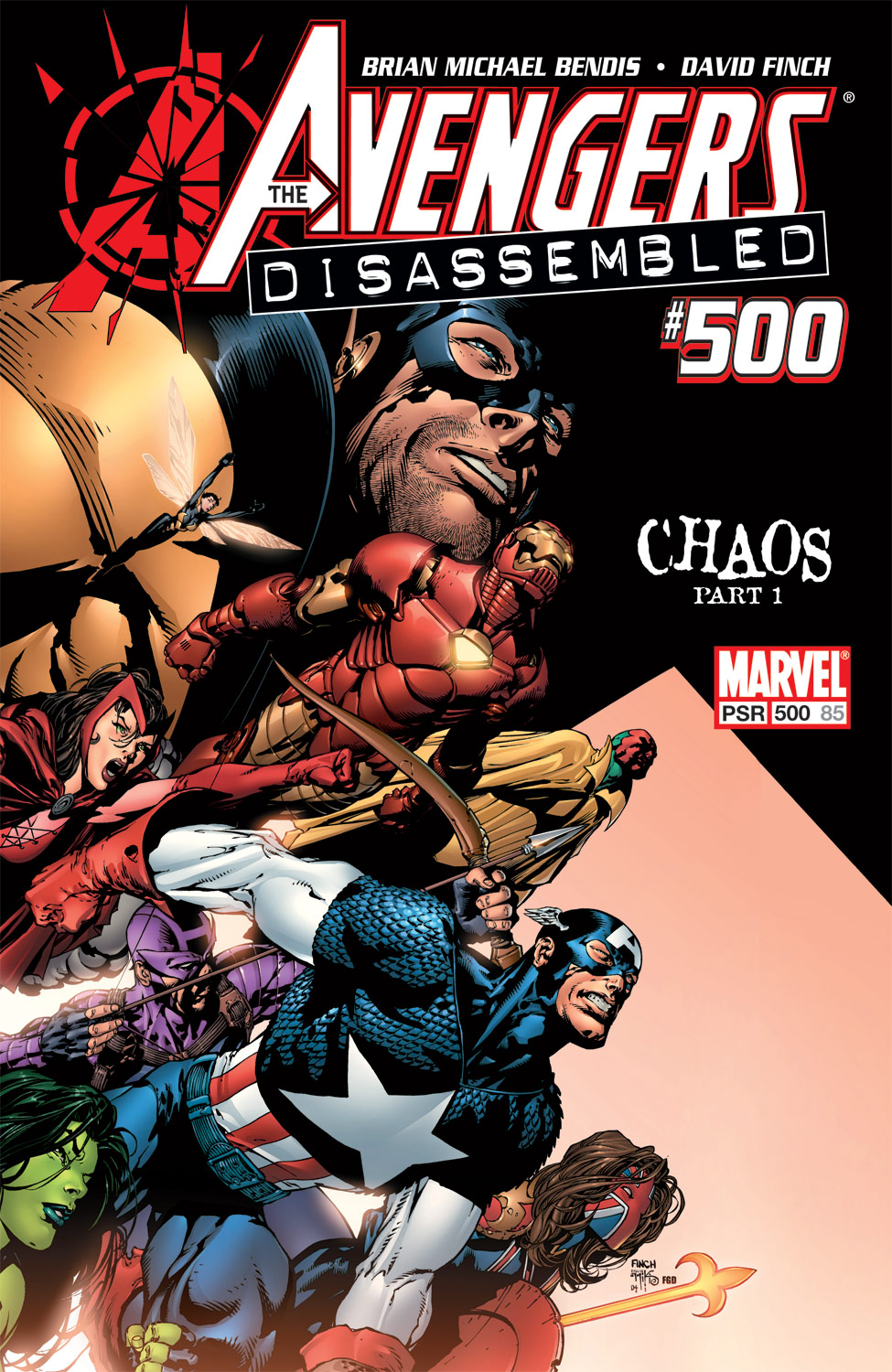
For example, Wizards of the Coast could consider introducing internal conflicts within the roster of main characters, with or without an external force infiltrating the main team of heroes. For instance, we could envision an equivalent of Marvel’s Avengers Disassembled narrative arc, with the story focusing on the disbanding of the Gatewatch and the resulting conflicts between former allies.
Risultati immagini per avengers disassembled 1
Avengers Disassembled, Chaos (Part I of IV), cover art by David Finch

Another option would be to revisit the concept of time travel in Magic, as the last iteration of this concept came with the Tarkir block. Oddly enough, despite this being an almost unprecedented feat in Magic’s story, the repercussions of Sarkhan‘s time travel have limited effects on the Multiverse. Sure, the timeline of the Plane was drastically altered, affecting most Tarkir-bound characters, but most of the other Planeswalkers seemed to hardly notice the change.

Revisiting time travel would pose an interesting challenge to Magic’s heroes, as the Gatewatch has not dealt with time travellers, yet. And let’s not forget Emrakul is still trapped in the moon of Innistrad. A moon conspicuously made of silver, the only material in Magic’s lore that can travel through time.

A Blind Eternities proposal

Taking into consideration Mark Rosewater’s comment on the unlikeliness of a Magic set taking place within the Blind Eternities, I think we can still work towards a compromise. Let’s keep in mind that:

  1. The Emrakul storyline still needs to find some kind of resolution
  2. We need something new and different to come after Bolas’ long arc
  3. The Blind Eternities are a still unexplored setting that fans have often asked about

What if one of the upcoming stories revolved around a Plane breaking into the Blind Eternities? We are no strangers to world-ending threats in the Multiverse, but what if, this time, it was not happening at the hands of a powerful villain, but simply as an occurring phenomenon?

Or, if Wizards wanted to provide a single source of this event, what if this was the by-product of Emrakul being trapped into Innistrad’s moon? What if she was calling upon the Blind Eternities themselves onto Innistrad, from within her cage? And what if she was also doing so across time, ideally summoning towards herself even the other two Eldrazi Titans, which the Gatewatch thought defeated?

Risultati immagini per emrakul the promised end
Emrakul, the Promised End, art by Jaime Jones

This would result in an admittedly challenging storyline to pull off, but it would allow to:

  1. Complete or at least progress the Emrakul storyline – ideally with the main characters forced to release her from her prison and set her free again throughout the Blind Eternities, potentially accompanied by the time-shifted Eldrazi Titans
  2. Introduce a narrative arc where the main opposing force is a slumbering, almost unwilling entity and not a present evil mastermind – again, carrying a strong Cthulhu vibe and not simply reiterating the concept of a mastermind villain setting a complex plan in motion
  3. Depict the Blind Eternities as a portion of the whole worldbuilding – most notably the portion of Innistrad shifting into the space between worlds, while the remainder of the set still features typical Magic elements

The (colourless) opportunity

Setting aside Magic’s lore, I think it is worth mentioning that colourless Mana as a concept has recently seen a resurgence in popularity, especially in an open-ended and casual format like Commander. At the time of writing, the latest episode of Game Knights by the Commander Zone has marked the first appearance on the show of a fully colourless deck, piloted by Ashlen Rose. Her deck was also the subject of a dedicated episode of the same podcast, which helped popularizing colourless as a valid deckbuilding option for Commander players.

On top of that, we have never had a single colourless preconstructed deck in any of the Commander supplementary products. As I have already mentioned, I fully expect this year’s Commander supplementary product to mark the first time a colourless preconstructed deck is presented to the players.

The sensibility of casual players towards colourless is recently increasing, while support towards this archetype is still minimal. While it certainly wouldn’t make sense for Wizards of the Coast to cobble together a set just to ride a fairly localized trend, there is a number of elements pointing towards the big opportunity that a Blind Eternities set would present.

Moreover, if the four consecutive sets of Battle for Zendikar and Shadows Over Innistrad led to a justifiable Eldrazi fatigue, having a single episodic set taking place between Innistrad and the Blind Eternities would probably be an interesting divertissement before or after a larger storyline.

Migratory Route (CM2)
Migratory Route, art by Winona Nelson

Considering War of the Spark is likely going to close Nicol Bolas‘ narrative arc and assuming this summer’s Magic Core Set is not going to introduce major shakeups in the current storyline, I would expect the following set to take us somewhere new, after a full year of Ravnica-bound storylines. Then we may be off to New Phyrexia or Theros, where unresolved plots still demand our heroes’ attention, or we may be taking a much-anticipated detour to Lorwyn.

Between these future – and yet pre-established – plots, I strongly believe we have the opportunity to kill two birds with one stone: advancing or resolving Emrakul‘s storyline and introduce Magic players to the unfathomable well of creativity that are the Blind Eternities.

Revisiting the Commander Magic Quadrant with your Playgroup

Context and Methods

Back in February I wrote a proposal on how to use Gartner’s Magic Quadrant to map out a player’s Commander decks. The goal was to identify the links between one person’s fun and the appreciation the rest of the playgroup had for certain decks.

While the initial approach was but an interesting first take on the subject, most of the analysis was envisioned as a single-player perspective, with the idea of understanding if certain patterns could be identified. One thing that quickly jumped to mind was the possibility to enrich this analysis with a larger sample size.

Instead of just focusing on a single player, I wanted to see if the principle could be applied to an entire playgroup and what could be derived from such an analysis. The Commander Magic Quadrant (CMQ), after all, is envisioned as a resource for measurement of fun among members of a playgroup, so it just felt natural to build on this idea and see how many additional perspectives could be collected.

I was fortunate enough to recruit seven volunteers from my own playgroup and we organized a two-step evaluation, building on the principles of the original CMQ:

  1. First, each player ranked their decks in terms of personal enjoyment
  2. Then, each player ranked everyone else’s deck based on perceived fun when playing against them; since we had access to 40 decks, each player assigned a score of 40 to their favourite deck and proceeded with a descending ranking; quite intuitively, players voted for all decks but their own and the ones they did not have a chance to play against

With no way to quantify fun through a universal management, the two steps were translated into a ranking system along two axes:

  1. Personal enjoyment dictated the horizontal distribution of decks; since not all players had an equal roster of Commander decks, we simply agreed on a linear distribution, with equidistant decks along the X axis for each player
  2. Average scores of other players’ decks formed a single vertical ranking; since the 40-to-0 ranking was largely arbitrary, we distributed the decks, again with equidistant decks along the Y axis

To theorize players’ profiles and see if any pattern was perceivable, we kept track of deck’s ownership with a single letter per player. In the following paragraphs, I will be referring to the members of our playgroup, myself included, with the assigned letters.

The result of this analysis is summarized in the following CMQ.

The CMQ applied to our playgroup

Having access to eight players and forty decks, the result is quite dense and, on first glance, chaotic. Fortunately enough, we soon identified some interesting phenomena in the decks’ distribution.

A playgroup’s CMQ Areas

First and foremost, six out of the eight players had their personal favourite deck in the top right corner. Not only that, but two players actually had two decks and one player had three. All these decks were scoring high both in terms of personal enjoyment and playgroup’s appreciation.

Knowing both the players and the decks’ positioning, it became evident that these decks hold a special role in our own metagame, as each of these serves the implicit purpose of being the signature deck of the player. I will start with the two most interesting ones, though each of them presents a very notable case study:

  1. B is probably the most political player in our playgroup; he thrives in negotiations and he often takes a defensive stance within games; his non-aggressive nature means that he is rarely perceived as carrier of a negative experience for the group, hence three of his five decks ranked in the Masterpiece area
  2. F plays Black every time he can and both his Masterpiece decks feature a very strong Black component: his Xiahou Dun, the One Eyed deck is all about Graveyard recursion, while his Scarab God deck goes all in on the reanimation strategy; this deckbuilding practice is how he approaches almost every aspect of Magic, so it would really come as a surprise to see him pilot a Naya deck of sort

It is interesting to note how these signature decks seem to be separated by all the others, with an implicit line parting these beloved decks from the rest of the bunch.

Risultati immagini per academy elite mtg
Muzzio, Visionary Architect, art by Volkan Baga

The bottom quadrants of the CMQ, and especially the Aggressor area, feature a number of very powerful and very disliked decks. As the name suggests, each of these decks is infused with a strongly proactive strategy, either in the form of reliable and non-interactive beatdown decks, or dedicated combo decks.

Here we have R’s Kozilek, Butcher of Truth deck and G’s Ulamog, the Infinite Gyre deck, R’s Saskia, the Unyielding Infect deck and M’s Rashmi, Eternities Crafter combo deck, which is all about generating infinite Mana with Deadeye Navigator and Palinchron.

While strategies here may vary quite significantly, the common denominators are the usage of non-political strategies, the resilience to countermeasures and the usage of destructive methods that rarely lend themselves to interactive games. Much like the signature decks, these aggressive decks also appear to be separated from the rest of the sample by an empty zone, where we can trace a potential border.

The mid sections of the CMQ include a number of different decks. The left portion seems to feature many non-oppressive decks, most of which do not feature combos or non-interactive strategies. These decks tend to be moderately appreciated, thanks to their relative openness to interactive and political games. On the other hand, they bear very little resemblance to the players’ signature decks, often ending up as the polar opposite of what each player really loves doing.

If M is renown in the playgroup for his creative, powerful and explosive builds, his Bruse Tarl, Boorish Herder / Tymna, the Weaver Aggro deck runs the risk of feeling too linear and straightforward. If C is known to be a value-oriented player, helming a consistent and reliable Glissa, the Traitor deck and often indulging in Artifact-based strategies, his Jori En, Ruin Diver deck suffers from the lack of a similarly consistent engine and it is nowhere near the explosive potential of his Mayael, the Anima deck.

Outside of this zone of decks feeling atypical for the players helming them, we meet a sort of “neutral zone”. These decks are not radical enough to fall under any of the identified areas and end up in the middle of the CMQ, bearing characteristics of some areas, but without fully embracing them. Here we find G’s Emmara, Soul of the Accord deck, part Aggro deck, part Combo deck. Not far from that we meet M’s Avacyn, Angel of Hope deck, which falls in the middle of the vertical axis due to very mixed receptions from the playgroup.

Key areas identified in our playgroup’s CMQ

The best players

If Commander is all about the overall level of fun shared among players, a first approach to a playgroup can be taken by looking at the player with the highest average scores among all their decks.

I already mentioned how B is among the most political players in our playgroup and how C is renowned for his non-oppressive value-based decks. What is interesting is that, despite having very different playstyles and preferred colour combinations, they display very similar patterns in their decks’ preferences and reception.

B truly embodies the concept of White-Blue decks, bringing an implicit idea of fairness and justice in all his decks. If you take into consideration the fact that nowadays he rarely plays his Edgar Markov deck, all his other decks fair above average and most of them feature very similar colour combinations. If Rakdos is the colour combination of lust, violence and brutality, he is as far from that as one can be, often preferring reactive strategies to oppressive builds. A true testament to his political prowess comes with the fact that the two most appreciated decks of the entire playgroup belong to him.

A very different approach is what drives C in his deckbuilding efforts. We occasionally joke about how his three preferred decks, Glissa the Traitor, Mayael, the Anima and Saheeli, the Gifted follow a similar play pattern of establishing a small board presence in the early game, only to surprise the playgroup with a large, often colourless threat. The lack of oppressive combos and game locks makes sure that, despite these explosive plays, he is rarely perceived as a hardcore Spike, according to Magic’s personality traits.

Dispositions of players B and C

The Spikes and the Johnny

Speaking of Spikes, M, P and, to a lesser extent, V display a similar distribution to the Spike Curve theorized in the first article on the CMQ. Aside for one exception, each of these players seem to prefer decks that tend to be less liked by the rest of the playgroup, while they tend to appreciate much less the decks that are more thoroughly enjoyed by the rest of players.

While this is nothing to be blamed for, their rankings appear to simply be a manifestation of their Spike tendencies. When personal enjoyment is skewed ever so slightly in favour of victory, the result is an inverse correlation between opponents’ enjoyment and personal accomplishment.

P appears to be the most constant player in this, as his descending trend is almost perfectly linear, with just a small ascending bit on his Ezuri, Claw of Progress deck. Ironically, P is also the most erratic member of the playgroup, sometimes sacrificing deck consistency or in-game politics in the name of personal enjoyment. The results are strategies that veer between the hyper aggressive and the weird build-around.

M, on the other hand, displays a more varied take, with fluctuating trends and a significant peak in his Jodah, Archmage Eternal deck. Among the entire playgroup, he is the one who mostly enjoys playing around and breaking the rules of the format. Rarely does he play a linear and aggressive deck, opting instead for cheating Mana costs with Jodah, Archmage Eternal, destroying the entirety of his opponents’ boards with Avacyn, Angel of Hope, or playing off his opponents’ hand with Sen Triplets. This is where his Johnny nature emerges the most, as he is not interested in simply winning a game with a non-interactive combo. He wants to break the implicit rules of the game, to win with something he perceives as his own creation.

Dispositions and trends of players P (brown) and M (red)

V displays a similar descending trend, although the fact that he only currently plays two different decks strongly limits the number of trends that can be theorized.

Nevertheless, the common factor of these three players is that their decks largely end up being perceived as quite aggressive and imposing, at the cost of the playgroup’s fun. Therefore, the majority of their decks fall below the playgroup’s average.

The twins

The truly unexpected finding was the similarity between two players’ patterns. Before going in the details, I’d like to preface the graph with some notable elements:

  1. Both players currently own eight Commander decks: one colourless deck, two mono-coloured deck, three two-colour decks, one four-colour deck and one five-colour deck
  2. Both players built an Eldrazi-centred deck, which is among the least-enjoyed decks within the rest of the playgroup
  3. Their signature decks are both two-colour decks; both are strongly Commander-centric, as the entire deck is built around the Legendary Creature at the helm
  4. Their second favourite decks are also strongly Commander-centric and they both feature a relatively low Creature count
  5. Despite a very different composition, their third favourite decks are both Tribal or mostly Tribal; both these decks are relatively disliked by the playgroup; the same applies for their seventh favourite deck
  6. Their fourth favourite decks are exclusively or primarily White and Green; both these decks received average scores among the rest of the players
  7. Their fifth favourite decks are both four-coloured; they are both built around a Commander 2016 Legendary Creature and not a pair of Partners; they are vaguely disliked by the playgroup, due to their usage of hardly interactive strategies
  8. Their sixth favourite decks are two-coloured; these share similarities to their signature decks, with an overlap of one of the respective colours; these decks are fairly appreciated by the playgroup
  9. Their least favourite decks are both mono-Red; these two mono-Red decks are both chaotic in nature and not necessarily competitive
Risultati immagini per twincast mtg
Twincast, art by Christopher Moeller

Oddly enough, the two players tend to have a fairly different playstyle, with G preferring proactive strategies and R often approaching games with a more reactive behaviour. During games, G usually likes to be perceived as a potential game-breaking threat, holding the table hostage under the promise of an incoming, usually Infect-based, assault. R, on the other hand, tends to play more conservatively, often holding onto key cards in his hand and manipulating players into exhausting their own resources, instead of being the proactive force propelling a game.

Moreover, their individual evaluations of the playgroup’s decks are rarely similar, proving that they also tend to seek different play experiences from the rest of the playgroup. If one likes aggressive and fast-paced games, the other tends to seek a completely different method of board management.

Nevertheless, their placements on the CMQ are oddly similar.

Similarities between players G’s and R’s dispositions

How this is possible is truly beyond my understanding and I must confess a part of me is sincerely scared. I am currently blaming a mixture of randomness and cross-contamination of the two players, who may have evolved into having similar preferences, despite coming from completely different mindsets and backgrounds.

More data needed

Two players were able to submit only a handful of decks, due to currently having a fairly limited roster of options. One of them, F, is a veteran of the format, having played similar decks for the past few years. The other, V, is a relative newcomer to the playgroup and, although his decks’ placement seem to suggest a Spike trend, his sample size appears to be too small to clearly determine a trend.

It is worth mentioning, however, how F places himself in what really looks like a proto-Tablemate Curve, as we described it before. There seems to in fact be a direct correlation between his enjoyment and the playgroup’s appreciation for his decks. While this is not necessarily due to a complete commitment to the playgroup’s experience as the key aspect of his gaming approach, it is also worth mentioning that he has proven time and time again to be fairly adverse to straight up combo decks, of which his Gitrog Monster deck is a close approximation. And, as a result, it also is the deck he seems to enjoy the least.

Disposition of players F and V

It is worth mentioning that F is currently tuning a new Judit, the Scourge Diva deck, so we may be soon adding new data points to this analysis.

Variance

There was one final aspect I wanted to look at, as Kyle Carson gave me an extremely good idea when I first wrote about the CMQ back in February. All these analysis, especially on the vertical axis, have been performed in terms of evaluation of average scores. The higher the average score, the higher the appreciation of a deck within the playgroup.

Averages, however, only paint a part of the full picture. An analysis of the standard deviation associated to each deck could help expanding on the analysis, providing insights on how mixed or polarized a deck’s reception is.

In order to focus solely on consolidated numbers, we looked only at the decks that received five or more votes from the rest of the playgroup. Each of these decks was resized on the CMQ based on its standard deviation, so as to provide a quick overview of the relative variance between receptions of different decks.

Standard deviation of decks with five or more votes

First and foremost, it is interesting to note how the standard deviation of some decks drastically overshadows the one for others. R’s Grimgrin, Corpse-Born deck has a standard deviation of 2.16, while M’s Sen Triplets deck scored an impressive 11.21. The decks were evaluated six and five times, respectively. Similarly, B’s Ephara, God of the Polis deck reported a standard deviation of 2.77 among five received votes, while G’s Kumena, Tyrant of Orazca deck recorded a 11.10 standard deviation among six votes.

While listing all the decks would probably be lengthy and not necessarily useful, it is interesting to note how the two players with the largest standard deviations are M and G. Despite the two players having a fairly different profile of decks’ averages, their decks received the most mixed receptions. In fact, the five decks with the highest standard deviations belong to the two of them. On top of Sen Triplets and Kumena, Tyrant of Orazca, the two are responsible for introducing the playgroup to Rashmi, Eternities Crafter, Jodah, Archmage Eternal and Zozu, the Punisher.

The common factor of these two players seems to lie more in their in-game approach: both players are fairly proactive and aggressive in their playstyle, despite their different approach to the very concept of proactiveness. If G is more focused on frontal assaults and displays of power, M prefers a less linear plan, usually exploring routes that do not necessarily take him towards all-out attacks. To put it simply, I don’t think I have ever seen M swing with three different Creatures in a single combat phase, while to G that would probably feel like a fairly unimpressive feat.

A different representation of the decks’ variance comes with the visualization of minimum and maximum scores achieved by each deck. The results are quite interesting, as they highlight how some decks were ranked simultaneously among the top and the bottom by different players.

Minimum and maximum scores for decks with five or more votes

Among the most interesting examples, the already mentioned Sen Triplets deck piloted by M was ranked at the top by V and at the absolute bottom by G. While it is certainly not the only example of the intrinsically subjective nature or fun and enjoyment, its variance is the most notable in the entire sample.

Conclusions

This analysis was made possible only by the collaboration of all the participating players. I am sure there is a number of additional analyses that could be performed, as well as perspectives to address. Nevertheless, I must confess I feel this is a good batch of results for a first comparative analysis within our playgroup.

Risultati immagini per comparative analysis mtg
Comparative Analysis, art by William Murai

Of course, I strongly recommend trying this yourself and see what you can derive from your playgroup’s analysis. Of course, it takes a lot of collaboration and effort, but the results are certainly interesting. And, at worst, you will have a better understanding of what your playgroup likes the most, so you can confidently pick the best deck to take to your local game store.

Before we close, I want to thank all the friends taking part in this effort. You can find some of them on Twitter, in case you want to ask about their decks and play stiles. In strictly alphabetical order: Marco “B”, Marco “C”, Luigi “G”, and Francesco “P” are all on Twitter. And a special shoutout to Kyle Carson for inspiring the standard deviation analysis.

Ten Modern Horizons Reprint Predictions

Modern Horizons

The upcoming Modern Horizons supplementary set is scheduled to hit shelves on June 14th, 2019. The set will be the first of its kind, featuring reprints from Eternal formats, as well as new cards designed specifically to support Modern, effectively skipping Standard legality. More specifically, all the reprinted cards in the set will now become Modern legal, potentially introducing dozens of Legacy and Vintage cards in the format.

This is a new approach for Wizards of the Coast, as, up to this point, supplementary sets like Commander, Conspiracy, Battlebond and Planechase have funneled cards solely into Legacy and Vintage, with no impact on Modern. As a result, Modern as a format has ended in a very tricky position, as all of its potential new cards would need to be printed in Standard legal sets first. This means that, up to this point, Wizards of the Coast has had no chance to print new cards straight into Modern.

This, however, is going to change with Modern Horizons. Wizards of the Coast now has a chance to print cards in either Standard, Modern or Legacy and Vintage, depending on whether new cards are printed in regular sets, Modern Horizons sets or other supplementary products.

With the set featuring no existing Modern card, but only a mix of newly printed Modern-legal cards and Legacy reprints coming into Modern for the first times, speculations are abounding. Will the set allow powerful Legacy staples to be played in Modern for the first time? Will only fringe playable cards be introduced? Will the newly introduced cards be threats or answers? Is the purpose to shakeup Modern as a format, or to complement existing strategies with new tools? Will we see new decks in the format?

With only a couple of new cards known at the moment, all we can do is speculate. So, brace yourself, because this is exactly what I’m going to do, here. What follows is my list of the top 10 cards I hope to see reprinted in Modern Horizons.

Serra, the Benevolent, art by Magali Villeneuve

Number 1 and 2: Counterspells

One key aspect of Modern, as it is right now, is the current lack of cheap hard Counterspell effects. Control decks are essentially forced to balance between expensive and powerful hard counters, such as Cryptic Command, and cheap conditional counters, like Mana Leak.

Legacy, on the other hand, is a format filled with interesting counter options, such as the staple that is Force of Will. The card currently acts as a sort of safety valve for Legacy, ensuring that, no matter what new broken card is introduced in the format, a powerful kill switch can always be deployed. Couple that with Daze and you have a number of free counters to keep in check the most problematic strategies.

I do believe Modern is fine with the current number of free counters, as Pact of Negation already serves the purpose of protecting key combo pieces. It is also my belief that Modern Horizons will not introduce Force of Will to the Modern format, but I do believe some other alternatives could be expected.

Most notably, Counterspell is the type of cheap hard counter that could really spice up the Modern format. Control decks already enjoy their Mana Leaks, but these cards tend to intuitively lose a lot of value as the game progresses, becoming less and less effective as Mana availability increases.

Alongside Counterspell, Flusterstorm is another card I would absolutely love to see printed. The card is going to often serve as a Spell Pierce equivalent, but the possibility to have another good one Mana counter in the format is really interesting for Azorius and Jeskai control strategies.

Counterspell, art by Zack Stella, and Flusterstorm, art by Erica Yang

As a side note, I would love to also see Mystic Confluence become Modern legal, but I think the card would too easily compete with relatively expensive hard counters, such as Cryptic Command. Definitely an interesting card, but I am personally a bit on the fence about its potential appearance in Modern Horizons.

Number 3 and 4: Cheap White Creatures

White Weenie strategies have existed in Modern for years, fluctuating between valid competitive decks and niche lists to hopefully catch opponents off-guard. Many Token based lists have evolved into the amalgam that Humans currently is: a deck that mostly resembles a collection of the best Creatures ever printed in Modern, randomly bearing the Human Creature type.

While every new Human card introduced in the future runs the risk of providing the definitive tool to make the deck “too good”, we can just look at our past to find a couple of very interesting options for a Modern legal release.

First and foremost, Containment Priest is a very interesting sideboard card to combat Aether Vial–based strategies, as well as the occasional Kiki-Jiki, Mirror Breaker variation. While I would not see the card sliding into any Humans main deck list, it would surely be a very respectable sideboard option.

Speaking of powerful Humans, Mother of Runes is a card I can see finding room both in the famed Human Tribal strategy, as well as within Bant Infect lists. The card is unquestionably powerful and it could either replace Apostle’s Blessing, or it could see play alongside it. Despite its power, the Modern format has a plethora of cheap cards that can deal with Mother of Runes as soon as she hits the battlefield, so I wouldn’t be too afraid of her breaking the format.

Containment Priest, art by John Stanko, and Mother of Runes, art by Terese Nielsen

Number 5: Black Signature Cards

Black’s colour identity is all about the pursue of power at any cost. The very idea of converting life into powerful effects is what Black truly excels at.

This is shown quite prominently in Modern’s most played Black cards. Thoughtseize and Surgical Extraction are among the most played cards in the entire format and they both feature a payment of life in exchange for a powerful, often discounted effect.

What we are truly missing, however, is a full dive into one of Black’s most famous and unique play strategies: reanimation. The current metagame of Modern sees Reanimate effects as a fringe strategy at best, with Goryo’s Vengeance seeing some play in Instant Reanimation decks.

Personally, I really think there could be room for a single additional piece of reanimation tech. While I am not even close to suggesting that the full trifecta of Entomb, Exhume and Reanimate should become Modern legal, I thoroughly enjoy the possibility of having just one of the three cards available in the format. I would love to see Modern players struggle and look for ways to play with the limited available options, assembling some kind of reanimation deck, without going all-in with Legacy staples.

Reanimate, art by Robert Bliss, Exhume, art by Carl Critchlow, and Entomb, art by Set McKinnon

Staying on theme of Black trading life for effects, I must add I would personally love to see Toxic Deluge sliding into Modern, but I am afraid the format is fine with unconditional board wipes costing four Mana or more. So, unfortunately, I’m giving Toxic Deluge a hard pass.

Number 6: the Best Land

Many experienced players have discussed about the possibility of introducing powerful Legacy Lands into the Modern format. While egregious names get occasionally thrown around, it is my belief that Modern Horizons will not include Wasteland, nor Karakas. Those Lands are extremely powerful in Legacy and their inclusion in Modern Horizons could very well lead to Modern becoming just “Legacy-light“.

Among all Lands that could be introduced in Modern from the other Eternal formats, the one I would really love to see is actually Ash Barrens. The card is one of the most beautiful and elegant designs of the past years and it can be easily introduced in the format without breaking it apart. It’s not an overtly powerful card, nor I think it is going to be a key component in any existing or new strategy. But it’s just too good to not be included in the format, at least for the purposes of increasing its availability and provide much needed reprints to the Pauper players.

Risultati immagini per ash barrens
Ash Barrens, art by Jonas De Ro

Number 7 and 8: Cheating Pauper

Speaking of Pauper, Modern Horizon is a great opportunity for Wizards to do something a bit tricky to help non-Modern formats out. Despite not being a fully supported format, Pauper is gaining increasing recognition, with more and more players joining the ranks of the Commons-only format.

Among the most talked about cards of the format, Oubliette and Cuombajj Witches are in desperate need for a reprint. Unfortunately, they are hard to reprint in a Standard legal set, as the card designs are significantly misaligned with the current sensibility of the Colour Pie. On the other hand, the much anticipated Pauper Masters sets seems to not be coming anytime soon, so Wizards may really want to sneak a couple of Pauper staples into another supplementary set.

This is why I think Modern Horizons could pose an excellent chance to reprint these two cards, making them Modern legal and, most importantly, increasing their availability. I know it feels like we’re cheating with the original purpose of Modern Horizons, but wouldn’t it be an interesting twist?

Oubliette, art by Douglas Shuler, and Cuombajj Witches, art by Kaja Foglio

Speaking of cheating, I would also like to mention another tricky reprint I would like to see in the set. Ophiomancer does not see much play in Legacy, but it comes with a nice and interesting piece of trivia. Its Black Snake Token with deathtouch currently does not exist in paper, meaning that the card is still somehow “incomplete”. So why not seize the opportunity of Modern Horizons to reprint the card and give it the Token it deserves? I must confess I don’t think this is really going to happen, but I guess it would be a very good surprise.

Number 9 and 10: Planechase Awesomeness

Baleful Strix is my favourite Magic card ever. It’s powerful, efficient and it plays extremely well in a number of Legacy decks. It is my belief that the card is in fact not too powerful for Modern, with the current meta being probably quite indifferent to cheap flying Creatures providing relatively small card advantage.

The beauty of Baleful Strix is that its impact on a format is not in introducing game-breaking combos, nor in enabling new strategies. The card is simply extremely good at supporting existing battle plans, increasing strategies’ reliability and managing problematic board states until a full plan can be set in motion.

Sliding the card in the format would likely help solidifying existing decks and maybe, just maybe, it would lead to a resurgence of Dimir Control lists. Would it see play in Death’s Shadow lists? Possibly. Would it completely warp the format? I don’t think so.

Speaking of interesting cards first seen in Planechase products, I would love to also see Shardless Agent popping up in Modern Horizons. Not because the card needs a reprint, nor because it is a particularly played card in Legacy. It certainly was, but it has relatively fallen from grace throughout the past years.

That said, the card would really help supporting a potential cascade-focused deck, featuring both Shardless Agent and Bloodbraid Elf. Cascade is just a fascinating mechanic and it is amazing for coverage purpose, providing thrills and interesting game moments whenever it is displayed. And, boy, does Modern need an injection of spectacular effects and thrilling suspense, after too many months of Krark-Clan Ironworks nonsense.

Baleful Strix, art by Nils Hamm, and Shardless Agent, art by Izzy

This is something I really hope will come as a byproduct of Modern Horizons: the inception of new decks in the Modern format, even if just as a new take on preexisting card. For instance, we already have a number of very good cards featuring the cascade mechanic, but these have seen play either as standalone gems in existing decks, such as Bloodbraid Elf in Jund, or as pseudo-combo enabler, much like Demonic Dread in Living End strategies. What if cascade became the centerpiece mechanic of a dedicated deck?

Notable Exclusions

While I know this is among the most talked about potential Modern Horizons reprints, I do not think we are going to see True-Name Nemesis in the set. Not because the card is too powerful for Modern, but because it’s not a good card to look at.

Any Legacy player knows that True-Name Nemesis is a very strong card, but I personally believe it does nothing good for the aesthetic of the game. The card just floats there, often unchecked, ticking continuously like a time bomb. Sure, Modern has a lot of ways to potentially deal with it, but is it really worth it?

Another card I would personally love to see in Modern Horizons is Teferi’s Protection. The card is extremely interesting and its sole existence can significantly warp entire games around it, leading to a challenging guessing game between players. Will your opponent have it? Are they just bluffing it?

It all makes for amazing mind games, but I must confess I dread a format where decks can play up to four copies of Teferi’s Protection, leading to potential nightmarish games where nothing happens and everyone keeps fading away.

A final honorable mentioned has to go to Sylvan Library. I believe the card would be absolutely fine in Modern, but I am setting it aside, for now, because of the its intrinsic complexity. It’s not that I do not trust Modern players with this effect, but Sylvan Library can play very similarly to Sensei’s Divining Top, which, despite being an amazingly iconic card, can often leads to excruciatingly long games. When Sensei’s Divining Top was legal in Legacy, too often we saw games of players just staring at each other, while taking turns pondering, thinking, deliberating and evaluating options.

Sylvan Library, art by Harold McNeil

What Modern Horizons Represents

Modern Horizons will be the first set of its kind, targeting a specific format and skipping Standard Legality with an injection of almost two hundred new cards. In a way, this is not unlike the printing of a new Commander preconstructed deck, which aims at supporting a very specific format, skipping Standard legality.

What is truly new, here, is that Modern is a competitive format. And it has historically existed in between the easy access of Standard and the elitist clubs of Legacy and Vintage. As a result, it is a format veterans can turn to, but it’s not really “the old school” format.

Modern Horizons could be a great step in the right direction of imbuing the format with a more defined identity, maybe setting a number of metrics and implicit characteristics that really help telling Modern apart from all other formats. As things stand, Modern currently incorporates bits from Standard, like a retake of the Standard Arclight Phoenix deck, obviously featuring a larger card pool and a stronger card selection, while also sharing many commonalities with Legacy, like the powerful Death’s Shadow deck.

It is also true that this could all pan out in a very drastic and potentially format-breaking way. Were Wizards of the Coast to inject the Modern format with a lot of powerful Legacy cards, the two formats may end up merging into very similar environments with, potential, Legacy itself dying. Many players are reading what they believe to be the signs of an impending doom for the format, such as the fact that MagicFest Niagara Falls will be the only MagicFest in 2019 featuring Legacy as its main format, while simultaneously taking place in a relatively hard to reach location.

On top of that, the Reserved List is still a very large elephant in Legacy’s room, essentially forcing all aspiring Legacy players to invest four-figure budgets in the format, or settle for a fairly limited number of alternative options. Take my opinion with a pinch of salt, but I am fairly sure the Reserved List is not going to be dismantled or revoked anytime soon. So if you’re hoping for Legacy to become a cheaper format, pick a number and know the line is going to be long.

Revel in Riches, art by Eric Deschamps

I must confess I cannot disagree with this perception. I am a Legacy Burn player myself and, if Modern Horizons were to introduce Chain Lightning, Price of Progress and Fireblast to Modern, I would be seriously tempted to make the jump and just move to a different format. One that could egoistically be more welcoming for a deck like mine.

While it’s too soon to predict what the future holds for both Modern and Legacy, the impact of Modern Horizons could really be huge for at least one of the two formats. Until more is known, all we can do is speculate.


War of the Spark Predictions and Death Bingo

The War of the Spark

The upcoming War of the Spark set, scheduled for release on May 3rd, 2019, will be the culmination of years of Magic storylines, narrative arcs, plots and conflicts. The story is expected to take place entirely on Ravnica, with a large ensemble of Planeswalkers converging on the City of Guilds. Based on everything we know so far, the story’s climax will depict the final showdown between Nicol Bolas, accompanied by his pawns and his Amonkhet undead army, and the Gatewatch, joined by a number of interplanar allies.

The Magic community is dead set on the idea that the body count of this battle will be at least remarkable. While we can probably rule out a complete genocide of all known Planeswalkers, many tried to predict the most notable deaths we will witness in the set.

Of course, as a fan of speculations, I wanted to throw my hat in the prediction ring. So, let’s dive head first in a rundown of all Magic Planeswalkers and their presumed fate after the War of the Spark! But before we do, let’s set a couple of ground rules:

  1. For the purposes of this list, I will be only focusing on Planeswalkers that have appeared at least once in printed card form before War of the Spark; so, no Davriel Cane in this list, although there is indeed a good chance he is indeed getting a card as part of the upcoming set
  2. Only Planeswalkers will be eligible for the list; while I would love to see Prime Speaker Vannifar go, she is not a contender, here 
  3. I will then try and set my predictions into a bingo card, picking the twenty-four Planeswalkers I think are more likely to die
  4. For the purposes of this list, characters fleeing, missing in actions or whose fate remains uncertain will not be counted as dead; however, characters turned into Zombies will or transcending into a different state of being will

And finally, a quick disclaimer. I know we have been recently confirmed that thirty-six Planeswalkers will get a card in War of the Spark. However, it is my belief that not all of them will actually be present on Ravnica at the time of the battle with Nicol Bolas and the Gatewatch. So, yes, many of these characters will indeed have cards in the set, but they will not necessarily be in the story, in my opinion.

Ok, with that out of the way, let’s go!

Collective Voyage
Collective Voyage, art by Charles Urbach

Not on the board

Let’s get this out of the way immediately. I personally do not think we are going to return to Theros to rescue Elspeth soon. Instead, I do believe she will appear as a surprise deus ex machina on a different Plane, having already escaped Theros’ Underworld on her own or with someone else’s aid. But with everything happening in War of the Spark, I do not think this is when we’re going to get her surprise return. She’s absolutely coming back, but not now.

Jiang Yanggu and Mu Yanling are not going to be involved in the War of the Spark. And if they are, they are definitely not going to die. We simply do not know enough about them at the moment, so their potential demise would not resonate with players. What I really hope to see, instead, is a new version of these two characters in one of the upcoming sets, so that we get to know them a little more.

If he hasn’t perished already, Koth is still punching Phyrexians on what was once Mirrodin. There is no way he is leaving that battlefield for Ravnica’s. He is a hero defending his home and, for all intent and purposes, he is going to keep defending it.

Like Jiang Yanggu and Mu Yanling, Rowan and Will Kenrith need way more build-up before their death gains any emotional relevance. They are certainly an amazing pair of characters and I look forward to seeing them again, but, at best, they will only have a cameo in War of the Spark. And it will not be their last stand.

Sorin is stuck inside a stone on Innistrad. An unlikely escape, only to have him immediately killed on Ravnica, would be the most Edgar Wright thing I can imagine from the upcoming set. So, no, it’s not happening. Sorin is very safe.

Tibalt is absolutely safe. And I’m saying this simply because, given the odd reputation of the character, his death would be taken mostly as a joke, with little impact on the whole story. He is probably going to show up at a later stage, hopefully redesigned into the evil and powerful villain he deserves to be.

For the sake of completion, I do not think Aminatou and Estrid are going to join the fight at all. So, for me, they’re out of the death ballot.

Safe and sound

If Angrath dies, I riot. He just escaped his long captivity on Ixalan and he just reunited with his two daughters. I cannot imagine him wanting to immediately set course towards a world of war and struggle, only to die fighting people he does not even know. Angrath is going to be fine.

Arlinn Kord has no direct connection to the War of the Spark. She has not pledged any form of interplanar allegiance to the Gatewatch and, as far as we know, she is not going to be involved in the conflict. While I would love to see her again, now is not the time.

Part of what makes Ashiok amazing is that we know almost nothing about them. We know they are somehow entangled in a larger scheme, possibly involving Dack Fayden. But provided any connection exists with the Multiverse’s ongoing conflict, we do not really know how Ashiok factors in. Most likely, they will appear again as a surprise villain in a future set.

Ashiok, Nightmare Weaver
Ashiok, Nightmare Weaver, art by Karla Ortiz

Chandra is going to live. She is hands down among the best characters we have right now. She is strong, charming, awesome. She just reconnected with her mother on Kaladesh. And she recently discovered a deep connection to Jaya Ballard. Not only is Chandra going to be fine, but she is also going to be among the best characters in future narrative arcs.

Dack Fayden was last seen on Theros. His reputation as the greatest thief in the Multiverse does not really place him at the centre of the upcoming fight. Could he be a nice surprise character to join the fight? Probably. Will he die there? Not likely.

Now, Daretti is awesome. That said, he is either on Fiora or on Kaladesh, according to his Mythic Edition art. And while I would love to see him teaming up with or facing off against Saheeli, I don’t think he has any reason to join the battle on Ravnica. He’s awesome and he is going to live.

I also love Garruk as the Boba Fett of Magic. He shows up occasionally, he does something awesome and he leaves. As a character, Garruk is great at small doses. While it would be great to have him appear out of the blue in the middle of the conflict on Ravnica, I find it very unlikely that he’s going to die right away. But seriously, how awesome would it be to have him delivering the actual death blow to Nicol Bolas, only to scoff off and leave? I know it’s not going to happen, but how awesome would that be?

Much like Angrath, Huatli has almost no reason to be on Ravnica. Unless she is suddenly missing the trapping embrace of The Immortal Sun, she is probably going to stay away from the powerful Artifact and from whoever is carrying it. She is going to be fine.

We also know Jace is not going to die. You know it, I know it, everyone knows it. He is the face of the game and his demise, were it ever to happen, would be the key aspect of a future set. He is definitely not going to die in a grand melee of twenty Planeswalkers. But I really, really want to see him go, at some point. So I’ll leave him in the safe category, for now.

Kiora has almost no connection to the War of the Spark and her signature powers do not really lend themselves to a good use on Ravnica. There is a very loose connection between her, Zendikar, the Eldrazi and Nicol Bolas, but I find it hard to believe that she will join the brawl on Ravnica.

Like Kiora, Nahiri has a relatively loose connection to Nicol Bolas. While she is a very proactive character and she has proven to be quite effective in exacting revenge, she is not really out for the Elder Dragon’s blood. I think she is not going to be on Ravnica, but, considering most of her narrative arc is finished, her death during the war could be quite fitting. Again, I don’t think it’s likely, so I’m counting her as safe, for the moment.

Nahiri, the Harbinger
Nahiri, the Harbinger, art by Aleksi Briclot

Speaking of people with loose connections to Nicol Bolas, Narset could join the fight on Ravnica only if all the Planeswalkers from Tarkir collectively decided to take part in the War of the Spark. There is a good chance Ugin is joining the fight on Ravnica, but I am not sure he would bring Narset along. And if he did, I do not think she would be the one dying in the fight.

Ob Nixilis has an ongoing feud with the Gatewatch. He may be willing to come to Ravnica, lured by the presence of many Planeswalkers, to seek revenge. Should he choose to do so, I find it hard to believe he would actually be able to kill anyone. Nor I think he would get himself killed in the process. Ob Nixilis is currently one of the only two Black-aligned Planeswalkers we have in card form and the fate of Liliana is way more at risk than his. So, let’s give Ob Nixilis a pass, for now. Wizards of the Coast may be wanting to save him for a later role in the story.

Saheeli is on Kaladesh, she is fine and she will be fine. I don’t think she is even going to join the War of the Spark. Most likely, we will see her again in a future set. Personally, I would love to see her interacting with the hostile environment of New Phyrexia, were Artifacts are very, very different than the ones she knows from Kaladesh.

Tamiyo is an amazing character, but she has also been established as not really a first line fighter. She is a researcher, a scholar and an academic. She may have a role in the upcoming war, but she is not going to be involved on the frontline. She is fine.

Risky business

I think Ajani is relatively safe. However, his mentor for all role and heroic statue kind of paint a big target on his forehead, so I cannot completely rule out the possibility of a death at the hands of Nicol Bolas, considering the Leonin has unfinished business with the Elder Dragon himself.

During his adventures on Amonkhet, Hazoret foretold Gideon‘s fate. The prophecy stated that the White aligned Planeswalker was going to die at the hands of an immortal. While we don’t know for certain if this refers to a god, an Eldrazi or an elder being, the top contenders are probably Heliod and Nicol Bolas himself. On top of that, Gideon is currently wielding the Blackblade, possibly telegraphing the very cliché good guy with cursed weapon death in the very near future. I think there is a chance Gideon is going to die on Ravnica, but, personally, I view the odds in the 60% range.

Kaya is awesome. She is an amazing character, but she is so deeply involved in Nicol Bolas’ machinations that I think there is a strong chance she may be dying on Ravnica. Or, and this is also a very strong possibility, she is going to flee the scene when things go bad, becoming a Garruk–esque character, popping up occasionally, but otherwise keeping a relatively low profile in the economy of the Multiverse. Of all the Elder Dragon’s minions, I would say she is the safer one.

Kaya, Orzhov Usurper
Kaya, Orzhov Usurper, art by Yongjae Choi

Nissa is currently in a very weird spot. On one hand, she is the first member of the Gatewatch to willingly break her vow. After her departure during the Dominaria storyline, she has completely left the picture. As far as we know, she has no intention to join the fight on Ravnica, despite her defeat at the hands of Nicol Bolas on Amonkhet. On the other hand, she doesn’t really have anything interesting to do on an interplanar level. Sure, taking care of her own world of Zendikar is a noble task, but she doesn’t really have any major conflict to be involved in, at the moment. Where she to appear on Ravnica, we could be looking at her final outing as a major player in the Multiverse, although we may need a bit more preparatory build-up, to make sure her demise resonates with players, after a year of absence from the main storyline.

Samut, on the other hand has a lot of unfinished business with Nicol Bolas. We left her on Amonkhet, but I fully expect her to be seeking revenge against the God-Pharaoh. She is definitely showing up on Ravnica and she is also likely to be contributing in a significant way to the Gatewatch’s cause. She is not going to be the one delivering the killing blow against Nicol Bolas, but her sheer involvement in the war and her very personal and heartfelt motivations put her at risk of getting killed.

Sarkhan has proven to also be very committed towards Nicol Bolas-related matters, to the point of traveling back in time to prevent the Elder Dragon from killing Ugin. Sarkhan is a man of action and I fully expect him to show up on Ravnica. His personal ties with Nicol Bolas may lead him to even have a central role in the fight and, should this be the case, I would expect the Elder Dragon to manifest all of his resentment towards the Planeswalker who brought Ugin back into the picture.

Moving on, I do not think Teferi is necessarily going to die, but I would really appreciate it if Wizards of the Coast decided to send all the older heroes of Dominaria out in a blaze of glory. Teferi is a great character with a very peculiar set of skills, so his only odds of dying lies in the story team deciding to explicitly kill off all the old guard to pass the torch to the new generation of heroes. Possible, but not probable.

Vivien is weird. So far she has existed only to seek revenge against Nicol Bolas. This puts her very close to Samut in terms of motivations and role in the entire ecosystem of Magic. Practically, I think either Vivien or Samut is going to die and my money is more on the former, than the latter.

Vivien Reid
Vivien Reid, art by Anna Steinbauer

The next one is a bit controversial. I don’t think Vraska is going to die. We all know she is going to meet Jace, she is going to have her memory restored and she is going to turn against Nicol Bolas. This is when, I think, everyone expects her to die. On the other hand, I would really love to then see a Golgari character surviving the war and possibly becoming a key public figure on Ravnica. What if she became the new Living Guildpact? What an amazing turn of events would that be?

Dead meat

Domri could be a good candidate for a surprise death midway through the story. There is a good chance Borborygmos wants him dead and Domri himself is not famous for his calm and cautious temperament. I think there is a good chance he is going to bite the bullet, but his death will not be the big emotional moment of the story.

Dovin, on the other hand, is pretty much already dead. Dovin is going to die in the most satisfying way possible. You would expect him to be killed by Chandra in an act of revenge, but I think this will actually play out as a growth moment for the fire-based Planeswalkers. I think Chandra will have a confrontation with Dovin, she will prevail, but she will also spare his life, proving she has matured as a characters. Nicol Bolas will be the one actually pulling the trigger on the Vedalken, muttering something awesome and evil like “your servitude is no longer required”.

Doomfall
Doomfall, art by Darek Zabrocki

Another notable death: Jaya is going to die in the most dramatic and awesome way you can think of. She is going to die in epic fashion and it will be an emotional punch in everyone’s guts. In her final moments, she is going to hand her goggles to Chandra and she is going to whisper something impactful, like “there is another Skywalker”.

I also think Karn is likely to die. Not because his arc is finished, but because his intention to use the Sylex to destroy New Phyrexia is a bit too extreme for a self-proclaimed pacifist. So instead of sitting down and having a heartfelt conversation with the rest of the Gatewatch on how to approach the Phyrexian menace, I believe he could be dying during the War of the Spark, forcing the survivors to find a less Plane-destroying approach to address the issue.

Liliana is a very tough one. I could be completely off on this one, but I think she is going to die during the War of the Spark. But, in a surprising turn of events, we are going to meet her again in the very near future, brought back to life by the Raven Man himself. Maybe she will be resurrected without her Spark, maybe she will now be old and weak. But she is going to die on Ravnica first and her death will be among the most jaw dropping moments of the story.

Ral is going to die brutally. Either the Gatewatch takes him down for luring dozens of Planeswalkers on the Plane. Or Niv-Mizzet takes him down to reclaim the title of leader of the Izzet League. Or Nicol Bolas takes him down for messing around with Project Lightning Bug. Ral is so dead, it’s not even funny.

Of all the bad guys converging on Ravnica, Tezzeret is the one I like the most. He is cool, charming and menacing, but he still retains a lot of personality, despite being just a pawn of Nicol Bolas. That said, I am fully prepared to seeing him fall victim of this war, possibly consumed by all the powerful Artifacts he is carrying. Or, and this is what I really hope for, he could turn against his master at the very last second, engaging Nicol Bolas in a deadly duel, only to succumb at the hands of his enslaver.

Tezzeret the Schemer
Tezzeret, the Schemer, art by Ryan Alexander Lee

Nicol Bolas and Ugin

So, the whole conflict revolves around Nicol Bolas. He has a plan, he has schemed for years, he has plotted and deceived. He has played a major role in almost the entire history of Magic and he hasn’t lost a major battle in ages. He has come fully prepared to this war on Ravnica. But I really believe he is going to lose this fight. And, with that, he is going to die. Not because he is weak, foolish or not fully equipped for this fight. But simply because having him survive this fight would resonate very poorly with the audience. An inconsequential victory, with Nicol Bolas surviving the fight, escaping and swearing revenge would feel like a waste of everyone’s time. This is going to be the ultimate fight, with casualties on all sides. And Nicol Bolas, the one and only, the Elder Dragon, is going to succumb, purely out of players’ fatigue towards him.

How is this going to happen? Well, theories abound. Impaled on Gideon‘s Blackblade? His heart pierced by Vivien’s bow? Betrayed by Tezzeret? These are all good theories, but I really hope for something truly unexpected.

What I would really love to see is a surprise act of aggression by Niv-Mizzet. In the midst of the conflict, when violence is at its peak and heroes fall like leaves in autumn, I would love to see the Dracogenius reveal his own plan, taking Nicol Bolas‘ life and stealing his Spark. Not only would this be a surprise ending, but it would leave a sour taste in every hero’s mouth.

What now? Is Niv-Mizzet going to rise as a new interplanar threat? Is he going to use this power to rise as the new Living Guildpact or Ravnica? Is he going to instead disappear in the Multiverse, seemingly exiting the picture, only to reappear years later, even more powerful than before? Only time will tell.

Nicol Bolas, God-Pharaoh
Nicol Bolas, God-Pharaoh, art by Raimond Swanland

Ugin‘s fate, to be honest, is also very hard to predict. He has all the reasons to come to Ravnica and join the fight. He also has all the reasons to die in a battle against his own twin brother. That said, Ugin‘s status as a spirit is in and on itself quite puzzling. What I think is going to happen is a sort of transcendence of the character into a different state of being, like a Jedi becoming one with the Force, I think Ugin is going to be presumed dead, only to soon be revealed to have become a fully ethereal being. So, yes, he dies, but it’s not goint o be a full death. But I’m still going to count it as a death.

The bingo card

Having gone through all these Planeswalkers, I loved the idea of setting up a bingo card to try and see if I could score a line of five deaths. Just for fun, here is what I’m picking.

War of the Spark death bingo

Of course, I strongly encourage anyone who is interested in joining the speculation to setup their own card. It’s just the icing on the speculation cake.

More predictions

If you want to check out more predictions on who is going to die in War of the Spark, you probably already know the Internet is getting filled to the brim with speculations, theories, ideas and guesses. I cannot list them all, so I’d just like to point you towards two YouTube videos I found really well done and entertaining.

Ryan Gomez is surely to entertain you in this Magic Arcanum video for TCGPlayer. Most of his predictions are very, very good and he is just an amazing guy to listen to.

And do not miss Connor Macleod’s video. His channel is fairly new, but the quality of the content he is putting out is really amazing.

Commander 2019 Predictions and Metcalfe’s Law

What we know so far

Commander 2019 is the eleventh paper-based supplementary product to be released by Wizards of the Coast as part of their EDH themed series. It is the eighth iteration of the preconstructed deck series, which started back in 2011 with the first batch of decks, simply titled Commander.

Over the course of their history, Commander preconstructed decks have explored almost every possible colour combination, progressively abandoning the formula of five symmetrical decks per set and expanding freely on themes, tribes, concepts and ideas. If the first sets were all wedges, shards, single colours and colour pairs, the most recent decks have featured Cats, Lands and Dragons and Top of the Library as their core themes.

Much like the previous two iterations of the product, Commander 2019 will feature four decks instead of five, likely balanced by themes and concepts, rather than colours. The decrease in deck count is justified by the format’s nature itself, which, despite being open to any number of players, best lends itself to tables of four.

Not much more is known so far, though we can probably look at the most recent sets to see what, if anything, Wizards may want to course correct with this upcoming release.

Risultati immagini per chart a course mtg
Chart a Course, art by James Ryman

Commander 2018 was received with very mixed reviews by the community. While these preconstructed decks tend to always be greeted with at least moderate appreciation, many players noted how the 14% price bump was not really backed up by any increase in average card value for secondary market purposes. Jim Casale published a very good summary for CoolStuffInc.com, which I strongly encourage you to read.

Even though Wizards justified this price increase as a way to legitimize powerful reprints, these were in fact few and far between. Enchantress Presence was a very welcome reprint, but that alone was not enough to justify the increased price tag.

Moreover, a lot of complaints were directed at the very unexciting Mana base of each of the four deck. Krosan Verge is always a nice card to see in a preconstructed deck, but it’s not exactly a card that builds hype and desire towards a set. Even the Jund Land-themed deck had a surprisingly humble Mana base, with a number of disappointing cards thrown in to fill an implicit nonbasic Land quota. Of course, nobody was expecting three Fetchlands and three Shocklands per deck, but even just one Wooded Foothills would have been appreciated.

Risultati immagini per kazandu refuge
Kazandu Refuge, art by Franz Vohwinkel

Setting aside this negative aspect, it is worth mentioning how the decks had a surprising number of cards created specifically to fill existing gaps. Yuriko, the Tiger’s Shadow had limited use in the deck she was printed in, but she embodied the much-needed Ninja Commander many players had been clamouring for over the past years.

Tuvasa, the Sunlit was a bit of a compromise between the need for a powerful Enchantress and the need for a Bant Legendary Merfolk. While Merfolk players up to that point had to compromise between the Azorius Merfolks of Sygg, River Guide and the Simic Merfolks from Ixalan, Tuvasa, the Sunlit could easily fill the Bant gap, despite missing any relevant Merfolk text aside for her Creature type. Sure, the result is an Enchantress ability that feel a bit tacked on, but as an Enchantress player, I am not complaining.

Varina, Lich Queen was printed with almost the same principle in mind. Innistrad Zombies were traditionally in Dimir colours, while Amonkhet Zombies were mostly Orzhov. Do you want to play both in your Zombie Tribal Commander deck? Here, have this. Yennet, Cryptic Sovereign and Thantis, the Warweaver built on the same principle, becoming the default Commanders for Sphinxes and Spiders, respectively.

It is obvious that Wizards’ Commander design team is keeping a very keen eye on what is missing in the format and what players are hoping to see the most. And considering that these missing pieces have been among the most well received cards from the last set, I would expect this trend to continue.

What Commander doesn’t need (right now)

Both Commander 2014 and Commander 2018 featured Planeswalkers as their centre stage cards. And while they made for very interesting design choices, I am not sure a new cycle of Planeswalker Commanders is on its way. I am fine with the concept itself, but I do not think the format needs a yearly injection of four new Planeswalkers.

The crux of the matter boils down to the fact that Planeswalkers tend to slow multiplayer games down quite significantly, introducing Commanders that are not capable of dealing damage on their own and that, in turn, demand to be attacked to be dealt with, removing pressure from players’ life totals. They surely generate interesting subgames, but they don’t necessarily improve a format that does not actually need to be improved.

Is it a mechanic worth revisiting? Probably. Right now? Probably not.

Risultati immagini per lord wingrace
Lord Windgrace, art by Bram Sels

Partner is another mechanic that I must confess I am very on the fence about. First introduced in Commander 2016, the mechanic was revisited in Battlebond, where it was adjusted to limit its possible combinations. And if, on one hand, I like the Battlebond Partner mechanic, on the other I must confess its original iteration in Commander 2016 still feels extremely messy. To explain why, I’d like to frame it around Metcalfe’s Law.

The original version of Partner was interesting in the self-contained context of Commander 2016, where the number of combinations was large, but finite. Unfortunately, any new Partner that comes afterwards increases the number of combinations exponentially. This, unfortunately, is what throws a wrench into the works.

Adapting Metcalfe’s Law, it is intuitive how each new Partner introduces a number of new connections equal to the number of previously existing Partners. To put it simply, each new individual Partner card requires thorough testing with each of the existing ones, to ensure the newly introduced pair does not generate odd or overpowered interactions.

Popular representations of Metcalfe’s Law

We currently have 15 original Partner cards, for a total of 105 possible combinations. If we introduced just eight new Partners, meaning only two per each Commander 2019 deck, we would be adding 148 new combinations. This may tickle your deckbuilding fantasies, but think of how much playtesting would be needed to ensure none of the 253 resulting pairs accidentally breaks the whole format. Sure, most pairs may be intuitive to analyse, but the sheer impact of just eight new non-exclusive Partners would be huge.

What Commander needs

Commander right now does not need major improvements. As a format, it is very balanced and hardly including problematic cards. Sure, we have the occasional complaints against Cyclonic Rift, Expropriate, Tooth and Nails and other very powerful cards. But we also have had no ban in almost two years, after the departure of Leovold, Emissary of Trest. And the format is still thriving.

Rather than needing cards to be removed from the format, Commander probably needs key archetypes to be better supported or expanded upon. Aggro decks in the format tend to be weaker than Control strategies, mainly due to players’ increased life totals and the higher number of opponents to take down.

Unfortunately, Boros has been the de facto colour pair for pure Aggro strategies and this has limited its effectiveness and power quite significantly within the context of Commander. Aurelia, Exemplar of Justice has seen a lot of Standard play, but it is far from being a great Commander.

Firesong and Sunspeeker were a step in the right direction, providing a new twist on Boros that still managed to feel flavourful. Unfortunately, the card alone was not enough to restore players’ faith into the Legion. Not only that, but Firesong and Sunspeeker were a Buy a Box promo and many players did not have access to them.

The fundamental problem with Boros is not the lack of powerful cards, but the fact that it has to rely on inefficient colourless options to provide for the key components it is missing: ramp, card draw and recursion. Even alone, all other colours can do at least one of these excellently, while Boros struggles with some and completely neglects others.

To be completely fair, Red has improved quite significantly over the past years, with cards like Stolen Strategy filling in for much needed card advantage effects. White, on the other hand, has only recently started to catch up, thanks to the very recent printing of Smothering Tithe. What is still missing, however, is a Boros Commander that doesn’t necessarily need to be turned sideways to win games.

What I’d like to see in Commander 2019

First and foremost, I hope we get a new Boros Commander, either in a dedicated two-colour deck, or within a three-colour deck, where it just plays as one of the ninety-nine. We already have a plethora or big and aggressive Boros Legendary Creatures, so what I really hope to see is something in the vein of the followings.

The Celestial Trial, art from “Song of the Angels” by William-Adolphe Bouguereau and The Wounded Angel, art from “The Wounded Angel” by Hugo Simberg

I know the effects may lean a bit too much towards Black. But these proposals are nothing but general ideas, rather than actual designs that I hope to see printed. My hope is to finally see Boros get cheap, reliable Legendary engines that still play with the Legion’s signature Creature-based theme. Either by providing recurring card selection, or by introducing something not too distant from the impulsive draw effects we have already seen in Red.

I know this would not help Boros with its other weak points, such as ramping and recursion. But Boros itself is not necessarily a colour pair devoted to generating Mana or reanimating Creatures. At worse, these two new Commanders could play Smothering Tithe to ramp and Emeria Shepherd for recursion purposes. But, at least, we would have a starting point to build something new with Boros that isn’t just Aggro.

What you may be asking yourselves is: why now? Boros has historically been a problematic colour pair in Commander. Why should this be the year we get anything new for the Legion? Long story short: because the problem has become universally accepted, to the point of becoming a joke. Both Commanderin’ and The Command Zone podcasts have mentioned it time and time again. Gavin Verhey himself in a recent Commanderin’ episode has mentioned how Wizards is keeping an eye on Commander, with the goal of improving the most problematic and lacking colours in the format.

Another colour combination we have never seen represented in Commander preconstructed decks is colourless. Truth been told, the closest thing we have had was the Commander 2014 Daretti, Scrap Savant preconstructed deck, which was mostly Artifact-based. Support to this quite unique deck type has been minimal in recent Commander history and we have lived almost three years of Magic without a single mention to the Eldrazi. The Eldrazi fatigue we were all suffering between 2015 and 2016 is now long gone.

Commander 2019 could be a great opportunity to print a fully colourless deck, either themed around a Legendary Artifact Creature, someone related to the Eldrazi, or even Ugin himself. What if Commander 2019 was the set that gave us a transforming version of Ugin, the Spirit Dragon, not unlike the treatment Bolas received in 2018 with Nicol Bolas, the Ravager? And no, this would not go against my no Planeswalker in Commander 2019 prediction, because the frontman of the deck would be Ugin in its pre-ignited Creature form.

Risultati immagini per ugin the spirit dragon
Ugin, the Spirit Dragon, art by Chris Rahn

Assuming Boros and Colourless are really going to be showcased as two of the four Commander 2019 preconstructed decks, the two remaining decks could feature some of the colour combinations we are yet to see in this type of product. Azorius, Dimir, Rakdos and Gruul have never been showcased in a preconstructed Commander deck, so far, and I think this is where we could start looking at.

It is also no secret that a lot of Commander preconstructed decks have been at least inspired by the current Standard environment, providing an easy access to Commander for Standard players wanting to play their cards in a non-rotating format. This is why, for instance, the Edgar Markov preconstructed deck was printed alongside the Ixalan block, or why Varina, Lich Queen came to us only one year after the Amonkhet block.

This year the Standards sets were all about Ravnica. And while the sets featured a lot of familiar faces and newcomers, two Legendary Creatures have been notably absent, so far: we know Borborygmos has fallen from grace, but he is also very much alive. Similarly, Ruric Thar, the Unbowed is nowhere to be seen, despite a mention in Gruul Guildgate. On top of that, Ilharg, the Raze-Boar has been strongly hinted at being a crucial, possibly upcoming player in Ravnica’s conflicts. I fully expect War of the Spark to feature at least one of these three characters, but, with the expected plethora of Planeswalkers to be printed, I do not expect three different Gruul Legendary Creatures to appear in a single set. This leaves room for at least one of the three to show up in Commander 2019, either in a dedicated Gruul deck, or as part of a three-colour deck.

Jund was a colour combination we saw just last year with Lord Windgrace, so it’s safe to say the same shard is unlikely to be represented again in 2019. Assuming Naya is also excluded, due to the strong overlap with the theoretical Boros deck, we are left with Temur as a possible wedge. This is where I think a lot can be done in Commander 2019.

Temur as a wedge was only represented by the Riku of Two Reflections deck back in 2011. The deck was also notably absent from every Commander Anthology product so far, despite including some very popular and beloved Legendary Creatures.

On top of that, Ravnica Allegiance has introduced two different mechanics prominently featuring +1/+1 counters: Evolve in Simic and Riot in Gruul. Cards like Bolrac-Clan Crusher hint at interestingly cross-synergies between the two Guilds and, personally, I think this is a design space that can be very heavily expanded upon in a preconstructed deck. I can really see a new Temur deck featuring two new Legendary Creatures and maybe an Animar, Soul of Elements reprint. A new version of Borborygmos or Ruric Thar, the Unbowed or a first printing of Ilharg, the Raze-Boar could also be featured in the deck.

Risultati immagini per animar soul of elements
Animar, Soul of Elements, art by Peter Mohrbacher

We have finally come to the fourth deck. With Yuriko, the Tiger’s Shadow being such a well-received Legendary Creature from last year’s Commander product, there is a chance Dimir is going to see some further support in Commander 2019. We are definitely not going to see another Esper preconstructed deck, after last week’s Aminatou, the Fateshifter. I would exclude Grixis, as well, as it would lead to the set featuring three Red decks out of four.

Sultai would be an interesting colour combination to feature in a Commander preconstructed deck, as it has not been showcased in any product since The Mimeoplasm preconstructed deck from 2011. It is also worth mentioning that Muldrotha, the Gravetide is gaining a lot of popularity in the format and further support for Sultai Graveyard-focused strategies would be very welcome. On the other hand, The Mimeoplasm preconstructed deck has already been reissued in Commander Anthology Volume II in 2018, so we could be fine with no Sultai in Commander 2019.

With this deck being the only one from the set featuring Black, I would also assume that a lot of the its focus would be put on Graveyard shenanigans. And with surveil being such an interesting and well received mechanic in Guilds of Ravnica, I think a Dimir Graveyard-matters deck would probably be a safe proposal.

And maybe, just maybe, this could also be a chance to print a transforming version of Tezzeret, the Seeker, portraying the moment of his Spark’s ignition. Much like my Ugin, the Spirit Dragon guess, this would tie in beautifully with Ravnica’s storyline.

Wrapping up

Just to recap what I think we will see in Commander 2019 this year, if I were to put my money on four decks, I would probably go for:

  1. A Boros deck, primarily focused on Tokens
  2. A Colourless deck, possibly featuring Ugin and an Artifact theme
  3. A Temur deck, primarily focused on +1/+1 counters
  4. A Dimir deck, primarily focused on Graveyard shenanigans
Commander 2019’s preconstructed decks proposal

I think Battlebond Partners are also very likely to return soon. As they take relatively small design space in the economy of a whole Commander deck, it is possible that Commander 2019 will be including some of these pre-paired Partners. Much like the other enemy colour pairs, Boros already has a Battlebond Partner pair in Sylvia Brightspear and Korvath Brightflame, while allied colour pairs do not currently have any equivalent.

I think Commander 2019 could be a good starting point to progressively rollout allied Battlebond Partner pairs, starting with Dimir and maybe Gruul. Just for the sake of symmetry, these would probably not be the lonely frontmen of the preconstructed deck, but just two of the cards included in the list. I personally do not see Battlebond Partners in Commander 2019 as something assured, or even likely, but I sure hope to be wrong on this.

Ludevic, Deranged Alchemist and Grigher, Zombie Knight, arts from the WikiMedia Commons library

And finally, the pain point. With Wizards getting rid of the MSRP, I think it’s safe to assume Commander 2019 will be implicitly aligned with last year’s price tag. The actual retail price will be obviously based on the demand for the product and the reprints it will include. While I think we are nowhere near the desired one Fetchland per deck, the mixed reception of Commander 2018 demands a better reprint approach for this year’s product. Considering we are also headed towards three months full of releases, with War of the Spark coming in April, Modern Horizons in May and Magic 2020 in June, product fatigue will likely be an issue.

This is Wizard’s chance to step up their Commander game and really fill Commander 2019 with sought-after reprints. I’m not asking a Mana Crypt in each deck, but what if the Temur list included a Sylvan Library?

So, this is what I think we will see in August 2019. What do you think is headed our way in the upcoming preconstructed decks for this year’s Commander release? What colour combinations and themes are going to be featured?

Until anything official is shared, all we can do is speculate. But aren’t we Magic players great at speculating?

Resource Transformation, Cyclops and Paradigm Shifts

Turning raw materials into end products

In the previous article on Resource Management, we discussed the positional value of Lands within a traditional ramp strategy and traced prices for movements between one location and another. So far, we have mostly looked at how players can increase their amounts of available Mana through the course of the game. The main principle being that it is always beneficial to ramp resources upwards, rather than implementing some form of downward spiral of available Mana.

Nevertheless, the act itself of increasing the amount of Mana at a player’s disposal does not really win games. Much like what happens in a manufacturing company, increasing stocks of raw materials is not going to automatically generate an end product. We surely have focused at length on amassing as many resources as we could, but we have not addressed how to then put them into fruition. In Magic terms, we have spent Mana only to unlock more Mana, but we still have not transformed this resource into actual game-winning components.

I’d like to frame once again the next steps around my Borborygmos Enraged Commander deck, although a number of different ramp-focused decks can help paint portions of the same picture. And by “portions” I mean that Borborygmos Enraged will be introducing some interesting twists along the way.

Setting now aside the copious amount of ramp cards included in the deck, all serving the sole purpose of getting us to the desired critical mass of available Mana, we now find ourselves wondering how to convert Mana into actual action. At first glance, we are facing three main alternatives to invest our resources:

  1. Mana-to-Board (M2B): this is one of the most traditional ways Mana is invested in a game of Magic; resources are converted into board presence, allowing players to impact the game first-hand; a good example from the deck comes in the form of Avenger of Zendikar, actively converting Mana into power and passively increasing that same power thanks to following Land drops; the conversion rate between Mana and power is traditionally linear, with X/X creatures costing X Mana, although a plethora of external factors and effects can vastly alter this ratio
  2. Mana-to-Damage (M2D): this is the most direct option, allowing a straight conversion of Mana into an attack aggainst opponents’ life totals; Banefire is the primary example in the deck, although Magic has a rich history of Lightning Bolt-esque effects; their scalability and costs determine their effectiveness into widely different formats, such as Standard, Legacy and Commander; moreover, the conversion rate of these effects largely varies, from the linear ratio of Mana to damage in Banefire, to true outliers like Flame Slash, which trades off flexibility for raw efficiency
  3. Mana-to-Cards (M2C): a fairly underrepresented option in most Green decks, Mana can be directly converted into cards, re-filling players’ hands; while Harmonize is likely the most straightforward example in the deck, the recursion effects of Creeping Renaissance and Praetor’s Counsel serve the same purpose; the conversion rate again varies widely, based on cards’ colour, restrictions and scalability

Each of these transformations comes with the effect – or the by-product – of one or more cards moving between the main game areas. As the card transition in most of the provided examples is a single card, we could be tempted to consider these as a relatively fixed constant, with the obvious exception of M2C-related actions.

On the other hand, mapping each movement alongside its Mana investment can help putting things into perspective, despite being a quite challenging effort. The following graph maps both flows of Mana in solid colours and by-product flows of cards via transparent pointers. As anticipated, it is easy to see how the transparent arrows mimic some of the main movements paths we discussed as part of our previous discussion on Resource Management.

Mana consumption clusters and related card transitions

Putting it all together, it’s notable how, in the specific context of a dedicated ramp strategy, Mana eventually becomes both the key resource the deck aims at amassing, as well as the main fuel to guarantee the gameplan can be steadily carried out. Practically, the play pattern takes the form of a self-fueling engine.

Before we move forward, it’s interesting to briefly digress on how Magic as a game lends itself to creating a very rich environment of cross-contaminating effects. More specifically, the three main conversion options from the above map can largely affect each other, chaining together engines, loops and combos. And, quite often, this is where Commander really allows players to go all-in with their more synergistic builds.

Converting products

First things first, not all Magic decks include all possible forms of product conversion and cross-contamination. Many decks tend to primarily focus on just one or two options, aiming for consistency, more than untamed flexibility. I’d like again to go in the details on where Borborygmos Enraged places itself among the main cross-contamination options and how its ramp strategy pays off. But first, let’s see what the main product-to-product conversions are traditionally available as part of Magic’s environment.

To the surprise of nobody, the most obvious conversion of products comes in the form of permanents on the board dealing damage. This is how the majority of gameplay actions in Magic take place and it is likely the most intuitive product-to-product conversion. On the other side of the equation, cards like Precinct Captain and Blaze Commando guarantee the opposite conversion can also be covered, generating board presence when damage is dealt.

While this can be an effective back-and-forth loop of Creatures dealing damage, which in turn generates more Creatures, it is not necessarily what ramp decks usually look for. While certainly a concept worth exploring inside dedicated strategies, let’s turn our attention to the other conversion options, which Green-based strategies can easily look at for inspiration.

A value-oriented board presence can generate a significant card advantage, which than can be then re-converted into a continuously increasing board presence. Think of the value engine that is Beast Whisperer, which, in the right Creature-based deck, essentially becomes a self-fuelling machine. And for an example of tournament-winning Card-to-Board converter, look no further than Zombie Infestation.

Finally, back-and-forth conversion of Mana and cards is easily achievable, and sometimes abused as part of game-winning combos. Think Curiosity and its colour shifted counterpart Keen Sense, converting damage into cards. Pair any of these up with Arc Mage, converting cards into damage, and you set yourself for a nice value engine. Of course, you can also just bypass Arc Mage‘s discard option and go straight for the infamous Niv-Mizzet, the Firemind and Curiosity combo, for an immediate Damage-to-Card-to-Damage loop.

Main resource transformation patterns

The unexpected payoff

Now that we have framed the main product-to-product conversion alternatives existing in Magic, let’s take a step forward and see what can be enabled by a ramp strategy that, up to this point, has mostly proven effective in moving Lands around. As anticipated, instead of focusing on classic M2B ramp payoffs, I’d like to specifically use Borborygmos Enraged to frame our next steps. The card, in the end, is the primary reason why I wanted to dive into this Resource Management analysis.

First things first, Borborygmos Enraged is obviously great at transforming cards from the player’s hand into direct damage, along the Card-to-Damage transformation line from the previous graph. On top of this ability, the already mentioned Keen Sense pairs amazingly with Borborygmos Enraged, generating a Damage-to-Card-to-Damage loop not unlike Niv-Mizzet, the Firemind’s engine, provided the damage is dealt to players and not to Creatures.

However, Borborygmos Enraged incorporates a card type restriction that specifically demands the discarding of a Land card to activate its effect, while Keen Sense only guarantees that a random card is drawn. The problem of this unreliable engine can be tackled from two perspectives:

  1. Circumventing Keen Sense’s uncontrolled card draw: this is likely the easiest – and, arguably, most boring – solution, as Abundance is able to bridge the exact gap between Borborygmos Enraged and Keen Sense, effectively generating a three card combo that is likely to end the game on the spot
  2. Resuming our Resource Management analysis to understand how, Keen Sense or not, Lands can be moved once again, although this time shifting gears to pursue a different priority, other than pure ramping
Risultati immagini per rethink mtg
Rethink, art by Matt Cavotta

The paradigm shift

In the previous article on Resource Management, we focused on analysing the main flows of Lands as part of a ramp strategy and tried to understand the average levels of efficiency that could be targeted for each of the main flows. Once Borborygmos Enraged hits the battlefield, however, the priorities completely shift and the player’s hand suddenly becomes the position of higher value for available Land cards. If up to this point the goal has been to move Lands toward the battlefield, moving them back to the player’s hand becomes now the most crucial action, allowing us to revisit previous paths with a new perspective, as well as to explore new options. In other words, this is when the paradigm of traditional ramp breaks.

If up to this point the goal has been to move Lands toward the battlefield, moving them back to the player’s hand becomes now the most crucial action, allowing us to revisit previous paths with a new perspective, as well as to explore new options. And this is why I wanted to use Borborygmos Enraged as a reference point throughout this analysis. Its ability is pretty unique in the context of a ramp deck, as it completely subverts expectations of a traditional ramp-enabled payoff. And by doing so, it shines a light on a number of additional ways a player can manage resources.

Library-to-Hand (L2H) and Graveyard-to-Hand (G2H) have proven to be among the most densely populated paths in the whole strategy, in terms of card availability in a Green-based colour identity. Aside for direct ramp (L2B), tutoring and regrowing Land cards are already among the easiest actions the deck can perform. These paths have been discussed at length in our previous article and they continue to prove effective in supporting Borborygmos Enraged once it hits the battlefield.

The additional path than can be explored, in complete countertrend to the developing stages of the game, is Battlefield-to-Hand (B2H). This action invalidates a lot of the build-up performed up to this point, essentially destroying the long-terms benefits of ramping in favour of one-shot damage.

Mina and Denn, Wildborn is an excellent B2H engine, but the real star, here, is Storm Cauldron, providing a free way to reclaim any number of Lands from the board to the player’s hand. With a steady supply of Lands returning to the player’s hand, a Storm Cauldron played at the right time can really win the game on the spot.

Moving back to the play areas map, Borborygmos Enraged helps us tracing the yet unexplored Hand-to-Graveyard (H2G) path. Interestingly, this is the least value-adding path in the entire deck, as it comes with the complete exhaustion of a resource in the name of direct damage. From a Resource Management perspective, this is particularly critical, because the discarded Land is both a card escaping the player’s hand and a Land not hitting the battlefield, where its value up to this point would have been the greatest possible.

In other words, after an entire battleplan crafted around ramping as much as possible, the decks completely course corrects the approach, taking back all resources deployed up to that point and shifting gear into a completely different behaviour.

Main Land movements enabled by and supporting Borborygmos’ ability

This is where direct contingency cards like Life from the Loam and Groundskeeper become even more valuable, as they cheat on this resource exhaustion, buying back Lands after their use, opening back the G2H pathway we already discussed in our previous article. Life from the Loam especially gives its best when paired up with one or more cycling Lands like Tranquil Thicket, when its dredging capabilities and the Land’s cycling effect turn the two cards into a three-Mana six-damage engine.

A slightly more indirect way, again, passes through the battlefield, with G2B movements enabled by Crucible of Worlds and Ramunap Excavator.

Putting it all together

Merging all the perspectives we have analysed so far, it’s interesting to see how much all the main play patterns of the deck revolve around movement and transformations of resources. While fairly intuitive for a Magic player, the level of complexity involved is actually quite significant, with a number of moving parts and transformative resources that get manipulated, exhausted and recovered.

Even if we just ignore all the possible movements that exist in Magic and focus solely on what the deck primarily tries to do, we end up with a selection of different components that, from a strategic perspective, can be grouped into two main game moments and related play pattern:

  1. Setup and development: the initial turns of the game are fully dedicated to ramping and amassing as many Land as possible on the board; this is achieved either via direct Library-to-Battlefield (L2B) ramping and Library-to-Hand (L2H) tutoring, coupled up with the opening of additional Land drops (H2B)
  2. Operating speed: the later turns of the game, especially once Borborygmos Enraged is out on the board, are focused on setting up a continuous Hand-to-Graveyard-to-Hand loop with most of the available Lands, eventually passing through the board, recovering resources from the battlefield or, at worst, tutoring additional Lands from the library

As it’s to be expected, the merging point of all paths, transformations and paradigms discussed so far is quite dense.

Main Land movement during setup (green) and operating speed (red)

Interestingly, traditional ramp strategies in Commander tend to primarily focus on the setup and development part of the equation, amassing large amounts of Mana to then assemble their payoffs with game-breaking permanents hitting the board. As far as I am aware, Borborygmos is one of the only Legendary Creatures that so drastically lends themselves to a complete paradigm shift, actively working against its setup strategy to benefit from a self-destructive payoff.

The parallel to Resource Management within companies is also very peculiar: while resources are largely manipulated and transformed as part of a company’s production process, the primary goal is always sustainability. Companies, in the end, harness the power of innovation when they manage to transform their breakthroughs into sustainable practices.

Sustainability, however, is not necessarily the primary goal of this deck. Although a traditional ramp strategy is always pursuable, via Avenger of Zendikar-esque cards, the main target is to actually consume a critical mass of resources developed up to that point, converting them into direct damage, which itself possesses no board presence value.

Closing thoughts

Of all the Commander decks I have had a chance to play, Borborygmos Enraged is probably among my favourites. Not because the deck is extremely powerful – truth been told, it’s a good deck, but it’s nowhere near competitive Commander good. The main appeal of the deck is its extreme focus on managing resources through a fairly complex lifecycle, most notably playing towards a goal in its setup stage and then completely shifting into a different play pattern. Understanding when to shift from one phase to the other is truly what makes games interesting.

What fascinated me in this analysis of Resource Management and transformation is that Magic has clearly finetuned an implicit set of costs for each of these effects. And although the level of efficiency that can be achieved is largely set, a lot of in-game variety comes from how effectively each of these transformations is organized within a larger strategy. When each of this movement is executed is truly what makes the difference between winning and losing a game.

I must confess I have lost multiple games because I was a bit too trigger-happy with Storm Cauldron, dropping it too early and failing at maintaining a consistent board presence. The rule of thumb I have adopted over time is to shift into operative speed only when a reliable recurring engine has been setup. And even then, it’s always a roll of the dice, considering how much your opponents can interact with any predetermined battleplan.

In the end, as most Commander players know, each game is different and assessing threats and opportunity is always the real challenge. On the other hand, framing play patterns and in-game decisions with a deep awareness of the principles behind them can really make you feel accomplished as a Resource Manager.

Resource Management, Efficiency and Land Ramp

What is Resource Management?

As the name suggests, Resource Management is a broad term used to group together all aspects of the process of planning, organizing, scheduling, developing, allocating and monitoring of resources within a company or project, with the goal of maximizing the resulting efficiency. The easiest way to define efficiency, in this context, is as the ratio between the acquired benefits and the necessary costs to achieve them. 

Put it simply, Resource Management as a discipline aims at getting as close as possible to the point where the trade-off between benefits, costs, time and organizational effort is the most advantageous. To ensure this goal is constantly in focus and all means of improvement are explored, a lot of best practices have been issued over time and as part of dedicated summits, ranging from simple organizational hints to all-encompassing guidelines.

What iscrucial behind this concept is that Resource Management is in and on itself aprocess. Resource Management is not simply a one-shot analysis that isperformed to cut costs, but a continuous activity that literally fuels the entire company or project.

Magic, much like many other card and tabletop games, features a lot of resources to be managed. Mana is probably the first to come to mind, as it literally fuels the entirety of the game. Cards, life, sometimes Energy are further examples of resources within the game. What is interesting within Magic is that resources are continuously transformed through the course of the game. Just to provide some examples, Divination turns Mana into cards, Vesper Ghoul turns life into Mana and Necropotence turns life into cards. The conversion rate between each resource and the others have been finetuned throughout Magic’s history, removing from the picture any problematic card that could easily tilt the balance of the game. Hence why a card like Channel is banned in Legacy and Commander and restricted in Vintage.

Risultati immagini per channel mtg
Channel, art by Rebecca Guay

Transformation of resources is also a key aspect of the quantitative side of Resource Management. Time, labour and raw materials are turned into final products, money is turned into workforce, and so on. The more effective these transformations are, the closer a company or project gets to the highest possible efficiency.

However, one key difference between companies and Magic games lies in the progression of resources’ availability. Companies deals with budget that can be invested, raw materials that can be bought, workers that can be hired. The bigger the budget, the higher the resulting buying power. Magic, on the other hand, has intrinsic limitations that ensure players start each game on an equal footing and progress at the same speed. Setting aside Mulligans, players always start the game with the same life total, the same number of cards and the same predetermined progression of one additional card and one additional Mana per turn, provided Land drops are never skipped.

While resources can be increased, extinguished and transformed throughout the game, their flow, if left unaltered, is essentially straightforward. However, decks can set themselves to manipulate this predetermined progression to their benefit, managing resources to alter the course of the game.

Let’s start from the basics. Mana, its natural progression and how it is managed and transformed, especially within a deck primarily focused on Lands as a key resource for victory.

The Basic (Land) concept

Most Magic players know that using all available Mana every turn is one of the primary goals of good deckbuilding and effective playing. Mana Curves with significant holes and poor in-game management of Lands can make the difference between victory and defeat. Casting a Nessian Courser for three Mana on turn 3 is perfectly on curve. Casting it on turn 4 with a spare Mana that is left unused is, effectively, like casting the same card for four Mana. The benefit is the same, but the cost increases and, as a result, the efficiency decreases.

If, on one side, using all available Mana every turn is key, the linear progression of its availability can also be largely manipulated. A card like Rampant Growth, for instance, allows its caster to convert present resources into a future payoff. More specifically, two currently available Mana and one card are converted into an additional Mana on the next and all following turns.

Risultati immagini per rampant growth mtg
Rampant Growth, art by Tom Kyffin

The interesting aspect of this equation is that Land cards, as the primary sources of Mana in an average Magic game, are themselves cards. However, their value as resources changes based on their location. This is where we need to think a bit creatively, as companies rarely possess resources that generate different benefits based solely on their location.

Deck strategies largely vary in Magic, so, for the purposes of the following paragraph, I’d like to use my Borborygmos Enraged Commander deck as the reference point. The deck’s strategy is fairly simple:

  1. A number of Rampant Growth effects rapidly increase Mana availability as the primary deck’s resource
  2. To further speed up the process, a number of Exploration-esque cards allow additional Land drops, provided Lands are available in the player’s hand
  3. Therefore, cards like Seek the Horizon help ensuring Land drops are seldom missed, adding Land cards to the player’s hand
  4. Once a critical mass of resources is available, the deck attempts at closing the game via Avenger of Zendikar, Banefire, or Borboygmos Enraged himself
  5. As a contingency plan, alternative win conditions are included in the list, sometimes driving inspiration from typical Legacy Lands deck: the Dark Depths and Thespian’s Stage combo is present, as well as the evil pair that is Inkmoth Nexus and Kessig Wolf-Run

These bullet points intuitively make sense to any Magic player. But the meaning behind these lies in the intrinsic and transformative values these resources possess throughout the game and, more, specifically, throughout the game’s main locations.

Lands’ positional value and cost

Excludingexile, Lands can find themselves positioned in four main locations:

  1. The library: this is the starting location for most of the Lands in the deck; their value, in terms of generated benefit, is essentially non-existent
  2. The hand: Lands naturally flow to the hand at each draw step; compared to the library, here their value is significantly increased, although their generated benefit is limited; sure, they are cards in hand, but they are not doing anything
  3. The battlefield: for most of the game, the battlefield is the location where Lands generate their higher outcome; moving as many Lands as possible to the battlefield from any other area is almost always beneficial
  4. The graveyard: much like the library, the graveyard can host Lands that generate no benefit and possess almost no value; however, their accessibility, however, is slightly increased
The four main Land areas and their intrinsic value

Quite obviously, the deck’s main strategy in terms of pure Resource Management is to increase the value and benefit generated by each Land, which, as we said, is mostly based on their positioning between the four main locations. In other words, moving Lands from one location to another, so as to increase their beneficial impact, is the primary way to alter the natural progression of a game’s main resource availability.

Provided the only criterion being an increase in generated value, the main movements can be easily mapped. What is even more interesting is that Magic has tuned its costs throughout the years, coming to a point where prices for each of these movements can easily be found within well-defined ranges:

  1. Library-to-Board (L2B): this is quite likely the most important movement in a Land-focused strategy, to the point that its best example, Rampant Growth, has itself lent its name to all ramp-centred strategies in Magic; the price for this movement is usually two Mana, provided at least one is Green
  2. Library-to-Hand (L2H): depending on it restrictions this effect ranges in price between one Mana in Lay of the Land and two Mana in Sylvan Scrying
  3. Library-to-Graveyard (L2G): this movement has often very limited beneficial impact, to the point that it is either a by-product of a larger effect, as in Fork in the Road, or one of the modes of a self-fueling engine, as in Life from the Loam; as the benefit on its own is so limited, its cost is virtually less than a single Mana and, even then, a card granting just this effect would likely not be included in most decks
  4. Graveyard-to-Hand (G2H): much like L2G, simply returning a Land from your graveyard to your hand does not make an entire card; the effect can be stapled onto a Creature, as in Cartographer, where the cost of the effect is roughly one Mana; other times, a buy two, get one free discount is applied, as in Life from the Loam‘s main effect
  5. Hand-to-Battlefield (H2B): this effect is free for the first Land drop each turn; allowing a second iteration of this movement tends to be priced at a single Mana in Exploration, with a more or less linear progression in Azusa, Lost but Seeking, which allows two additional Land drops for two Mana – assuming the 1/2 Creature roughly
    costs one Mana; interestingly, the cost of additional Land drops as a repeatable effect is close, but not exactly equal, to the cost of having them as one-time options; for reference, see Enter the Unknown, taxing a Mana for an additional Land drop, while Summer Bloom demands two Mana for three Land drops
  6. Graveyard-to-Battlefield (G2B): interestingly enough, tracing a cost for this movement is quite hard; the effect is priced at two Mana for a single Land in Restore, at four Mana for all Lands in Splendid Reclamation, while permanent openings of this option tend to cost three Mana in Crucible of Worlds and Ramunap Excavator
The costs for Land movement between areas

Mana efficiency on a single-turn time horizon

Borrowing a bit from the Critical Path Method (CPM), it is easy to understand why direct ramp tends to be one of the most efficient paths for Mana growth, as minimal setup allows an increase with a 0.5 efficiency ratio on the following turn alone. This value is determined under the following premises:

  1. Mana availability is only measured with a one-turn time horizon; this is a drastic simplification, as it ignores following paybacks, but we are removing from the picture one-shot effects like Dark Ritual and we are not considering odd behaviours like Teferi’s Isle phasing; this approach also ignores following turns in the calculation, as, having no fixed data on the average game duration, this immediate payback feels like a good proxy to at least wrap our heads around the real return rate
  2. The discount rate for Mana between one turn and the next is neglectable

As anticipated, the resulting efficiency ratio of a straightforward ramp card like Rampant Growth, is equal to:

0.5 = 1 additional Mana next turn / 2 Mana spent this turn

A more complicated and slightly less efficient path revolves around L2H Land tutoring, followed by H2B additional Land drops. This generates the same result of an additional Land on the battlefield, at the cost of one additional card being played. Nevertheless, this path can still be very much worth pursuing under certain circumstances. For instance, decupling L2H from H2B ensures that each step can be executed autonomously. In Magic terms, this means that the two steps can be split across multiple turns, spending one Mana per movement, instead of two Mana on a single turn.

Moreover, the fact that effects like Exploration are permanent boosts to your available Land drop count means that the H2B movement only demands a one-time investment. This, obviously, is balanced by the fact that Exploration on its own does not guarantee that each of the additional Land drops is met, as it itself does not funnel Lands to the player’s hand. Hence, deckbuilding for Land-focused decks often demands the inclusion of Seek the Horizon effects.

Without going into the details of each possible path combination, it is interesting to see how different combinations of cards can build more or less reliable ramp engines. Interestingly, Magic can also creatively staple together multiple parallel effects, combining each effect’s individual cost. Just to name one, combine Lay of the Land and Rampant Growth and you get Cultivate.

Risultati immagini per cultivate mtg
Cultivate, art by Anthony Palumbo

Efficiency as an arbitrated parameter

Having established the cost of each movement, Magic itself serves as the arbiter to guarantee the efficiency of each effect, determined as its benefit-to-cost ratio, is maintained within safe boundaries. This is where the comparison with companies’ Resource Management efficiency breaks.

To put things into perspective, a card with a too favourable ratio would not get printed, or would immediately get banned upon realization of its raw power. Think Rampant Growth costing a single Mana, or Hour of Promise costing only two Mana.

On the other side of the spectrum, an extremely inefficient card would simply not see any play. Most Commander players would likely ignore a three Mana Lay of the Land, as the cost would be too high and the efficiency too low.

This arbitration does not exist in companies and project. While very inefficient Resource Management tends to be addressed and, hopefully, improved as fast as possible, no arbitration from above exists. Outside of the limitations of physics as we understand it, there is nothing preventing companies from constantly seeking the highest possible level of efficiency. Were a company to introduce a breakthrough in technology, improving its Resource Management to an unparalleled level of efficiency, the entire market sector would be shaken.

This, at the end, is what disruptive innovation is. History provides great examples of companies redefining the way resources are organized, transformed and, in general, managed. These breakthroughs often end up shaking the very foundations of the surrounding ecosystem. On the bright side, this is the very foundation of progress. On the other hand, the tilt in the ecosystem’s balance can drive off competitors that cannot follow the new pace.

Being a game and not a competitive market sector, Magic demands a constant balance of its many ecosystems. Innovation is continuous, with constant exploration and adjustments in its internal parameters. However, when introduced, disruptive progress caused by breakthrough innovations mostly causes negative effects.

In the face of extreme change, players may adapt to the new balance, discovering new peaks of efficiency. But, as a result, the quality of the ecosystem is negatively affected, polarizing all aspects o the ecosystems towards the newly introduced innovation. Just take Eldrazi Winter as an example: the Modern format indeed increased its internal efficiency, allowing faster Mana and more powerful plays. But the entire ecosystem was forced to adopt this change or inevitably perish.

Magic, as a competitive game, thrives in competition and not under the premises of a monopoly. As a result, Eye of Ugin was soon banned, despite having existed in the format for years. This, because only under the right circumstances it had introduced a disruptive Resource Management breakthrough.

More Resource Management fun

Having gone through basic Resource Management, efficiency and how it applies to ramp in Magic, the next step is looking at how resources are converted into an end product. More specifically, we will look at how Lands can close the circle and introduce a complete paradigm shift in the process we have analysed so far.

As you can imagine, Borborygmos will serve as the frame for a Magic-focused look into resource conversion. Stay tuned!

The Commander Magic Quadrant

What is a Magic Quadrant and how magical is it?

A Magic Quadrant is a graphical tool introduced by Gartner Inc. to easily communicate the state of the art of a market sector, usually mapping top-trending companies based on their vision and capability of execution. Many leading make their mission to strive for the prized title of Leader, which is only awarded to the companies that can effectively balance an innovative and compelling vision with a practical and tangible execution strategy.

The result is an easily-readable two-by-two matrix, with the Leaders in the top-right corner and the Niche Player in the bottom-left. As Magic Quadrants are periodically re-issued, investors are strongly encouraged to keep an eye on significant movements between one Magic Quadrant and the next. An improvement of a company’s vision or the worsening in its execution capability may lead to significant shifts in the composition of power within a specific market.

Gartner Inc.’s Magic Quadrant

I will gladly spare you the details of how Gartner Inc. performs its analyses, how companies are assessed and how much effort is put into what looks like a very simple chart. It’s a very interesting read if you have some hours to spare. What really sells Magic Quadrants, to me, is how incredibly polished and readable the final product is. Just a peak at any Magic Quadrant provides a very synthetic and clear view at an entire market sector, pinpointing true innovators, followers and everything in between.

Magic Quadrants have then been often revisited, and even bastardized, to map more than companies. Products, concepts and even vague principles have often been diagrammed on different axes, as the very idea of a two-by-two matrix is both easy to convey and helpful in solidifying strategies and innovations. I myself have been guilty of abusing this graphical tool to present proposals, analyse critical choices and, yes, even debate restaurant options with my friends. The truth is, once you get used to it, it really is an amazing resource.

Recently I had this idea of applying the concept to my roster of Commander decks, to help myself framing my deckbuilding choices and maybe understand what to bring at my local game store, at the next Grand Prix or at my friends’ kitchen table.

Adapting the Magic Quadrant for Commander

Commander is a format primarily devoted to fun. While it is nowhere near a non-competitive format, its multiplayer nature, its intrinsic randomness and the existing of the long-discussed Social Contract make it way more devoted to fun and enjoyment, rather than competition. To put things into perspective: many Commander playgroups promote a spirit of collaboration in deckbuilding and deck selection, as it is often customary to ask the whole table what they’d rather see played. On the other hand, I have never seen anyone approaching a Legacy Tournament asking their opponents what would be funnier to see at the table.

The strive for shared fun, of course, is not the only criterion determining the quality of the overall Commander experience.  While making sure you are playing something funny for your opponents is certainly important, shuffling a deck you enjoy yourself is also crucial. In a perfect Commander world, we’d all play decks we truly enjoy and we’d only battle against decks we love seeing on the other side of the table.

There is probably at least a dozen additional perspectives to tackle when discussing Commander and I am sure many of them would be amazing subjects for future discussions, but let’s start from the very core of the format: fun. Fun for the player piloting the deck, as well as fun for the rest of the table. In other words: how consistently can each player define a vision they can enjoy for their deck? And how consistently does it impact on the rest of the playgroup?

In a way, this is not too different from Gartner Inc.’s perspective: a horizontal axis devoted to clarity of vision, which is in and on itself a relatively individual point of view, and a vertical axis focused on how this vision impacts the surrounding environment, in terms of execution and repercussion on the rest of the playgroup. Only this time, instead of whole companies, we can look at individual Commander decks within a player’s roster of available decks.

What I ended up with is the following two-by-two matrix.

The Commander Magic Quadrant (CMQ)

Much like Gartner Inc.’s Magic Quadrant, we end up with a two-by-two matrix, aimed at mapping Commander decks within four areas:

  1. Masterpieces are the best of the breed; decks that are both funny for the piloting player and for the rest of the playgroup; they are always a welcome sight at the table and they embody the playgroup’s understanding of what Commander truly is; these can be the culmination of a process in which the whole playgroup learns to understand and respect everyone within it
  2. Aggressors can be the joy of their owner, but a pain for the rest of the tables; decks that are extremely competitive, or include many of the most frowned upon cards in the format can easily end in this category; when these decks show up at the table, they are often met with groans and complains, with their pilot grinning in evil content
  3. Entertainers are loved by the table, but are not equally enjoyed by player piloting them; either these decks are extremely non-competitive, or they are simply closer to the playgroup’s expectations, rather than their deck builder’s; they could have been built this way on purpose, or they can be a meeting point skewed in favour of the playgroup’s preferences
  4. Roughs are the most challenging decks to analyse; they may have been poorly conceived from the start, or maybe they are failed experiments, or they simply lost their charm over time, becoming way more repetitive than expected; another option is simply that, while being still good and playable, they are not as good and beloved as the other decks in the playgroup

Before we move forward, one thing must be mentioned. The Commander Magic Quadrant (CMQ) is not a Cartesian Coordinate System. Its axes do not necessarily go from zero to a maximum possible number, nor usually include negative values. Practically, this means that the centre of the CMQ is not some kind of perfect balance, nor the bottom left corner represents the absolute zero.

The best way to approach the CMQ is to view each item mapped in its areas based on the relative positions between one another. The positioning of each item is therefore not absolute, but can help understanding, within one or more player’s deck roster, how each fare against the others.

Let’s get in the details of this CMQ and understand how to approach it and what its main takeaways can be.

How can one measure fun?

Long story short: fun is unmeasurable. You could try and quantify the amount of endorphin and other substances released by your body when you have fun, but I’m not a doctor and, really, this is way out of my league. What you can do, is separately tackle each of the perspectives we discussed, not trying to measure them, but simply ranking the decks you are trying to map. In other words:

  1. Fun for me: try and rank your decks based purely on your personal enjoyment when you play them; forget your opponents, your win rate, the amount of money spent building it, the type of decks; write them down and, based purely on the amount of fun you usually have playing them, try and list them for the funniest to the least entertaining for you to play
  2. Fur for my opponents: what is your playgroup’s reaction when you bring a certain deck to the table? Do they groan or cheer? Do they smile or complain? Talk to your playgroup and ask them to rank your decks based on how much they enjoy playing against them

Once you have ranked all your decks based on your and your friends’ enjoyment, try and place them in the graph. Funniest for you go to the right, funniest for your playgroup on the top. Again, do not think absolutes, here, but try and distribute all your decks evenly along the two axes. Personally, this is what I ended up with, when I tried distributing my decks.

The Commander Magic Quadrant (compiled)

What really drew my attention, here, is the outliers that place themselves far from the centre of the CMQ. While some of these decks are relatively easy to understand, some may require a bit more context:

  1. My Diaochan, Artful Beauty deck is a pretty straightforward Wacky Chaos Commander deck, with a dense Red Planeswalker subtheme; it is one of the most welcome decks in my playgroup, as it is almost incapable of winning and it always provide some nice twist to traditional games; it fares very low in my personal enjoyment scale as many of its games are just auto-piloted by a number of random effects and the end result is kind of lacklustre
  2. My Kozilek, Butcher of Truth deck is almost the polar opposite: it’s a powerful one trick pony that plays amazingly, but it can be extremely oppressive to play against; meeting a hasty Eldrazi Titan on turn 3 is everything but a funny experience for my opponents and the sheer density of Mana Rocks usually means the deck’s plan feels very consistent and reliable – which is good for me, but not great for the players on the receiving end of an Annihilation 4 trigger
  3. The top positions are split between my Grimgrin, Corpse-Born and my Borborygmos Enraged decks; the two decks have been tuned after years of games and their playstyle is usually perceived as very non-oppressive, relying on anything but game breaking locks and hardly interactive combo
  4. The worst offenders are probably Saskia, the Unyielding and The Locust God; they are both extremely linear in their strategies, but turn out to be less consistent than Kozilek, while still being perceived as pretty non-interactive; the former can potentially take out a player within the first turns of the game, while the latter wins more via a single explosive turn, rather than after a long and well-fought battle

The easier takeaway from this exercise is that I can easily cherry pick what to bring at my local game store, balancing good and interactive games with the occasional nonsense we all need sometimes. This is a great starting point, but we’re barely scratching the surface.

So what is fun?

One thing that immediately comes to mind looking at this matrix is how much one person’s fun can relate to everyone else’s at the table. While the amount of available data is not sufficient to really plot a quantitative correlation, it is indeed possible to theorize some patterns based on one person’s character. In a way, we could easily diagram two perfect extremes in a Commander player’s personality.

To some players, fun is a zero-sum game. The amount of fun they are having is inversely proportional to the amount of fun everyone else is having. If they win, they usually do so by performing something extremely unfair within the game. Joy, to them, is an exclusively individual perspective and the fact that the opponents are having fun can actually be a detriment to their own enjoyment. To some extent, this is an extreme version of Spike from Magic’s personality traits. If they win and everyone else loses, they are happy. Any other scenario results in their discontent. Push it even further and they look like psychopaths who thrive in everyone else’s unease.

On the complete opposite of the spectrum, you have the perfect tablemate. This player’s fun is directly proportional to the amount of fun the whole table is having. Victory is irrelevant, with their only goal being the maximization of the enjoyment within the entire table. Think of these players as Group Hug players pushed to the extreme, to a point where everything they do is make sure everyone else is having fun. Winning a game is so low of a priority to them, that they genuinely never care about the outcome of a game. Again, the extremization of this profile is some kind of selflessness-devoted zealot who only aims at entertaining everyone.

Main character curves on the CMQ

Based on the way one may have plotted their own Commander decks on the CMQ, it is possible to theorize the personality of a player and their approach to the game. The more they approach the Spike curve, the more likely they are to adhere to the idea of a “pure” Spike player, hellbent on winning the game with complete disregard for the opponents’ entertainment. On the other side, the more players approach the Tablemate curve, the more likely they are to move towards a goal of maximized fun for the whole table, disregarding victory as a crucial factor in their own appreciation for the game.

Of course, every player is their own person and it is very likely that perfect adherence to a specific curve is never really achieved, unless the data available is extremely limited, skewing the plotting as a result.

What else there is?

Bridging outside of a single person’s Commander deck roster, two perspectives can be further analysed. First and foremost, comparing individual player’s CMQ can generate interesting comparison between members of a single playgroup, with some being more inclined to individual fun and others more prone to shared entertainment.

With some patience and a lot of effort by everyone involved, another perspective that can be approached is a collective effort within the whole playgroup to rank the entire roster of available Commander decks each player can bring to the table. Based on the size of your playgroup, this can really be a true feat of organizational skills and debate moderation, with the end result being a single shared vertical axis for the entire playgroup. As a result, instead of looking at individual placements of each deck, one could trace the average location of each player roster on the shared CMQ, tracing relative players’ profile and mindsets towards the format and the rest of their teammates.

I may be trying this out for a future update on the subject, so stay tuned if you’re interested.

Glimpse the Future (M14)
Glimpse the Future, art by Andrew Robinson

One additional perspective that can be tackled, going back to an individual’s point of view and driving inspiration from Gartner Inc.’s Magic Quadrant, is a periodical re-assessment of a person’s CMQ. Our personal appreciation of our own Commander decks can really change over time, with new cards being released, new deckbuilding choices to explore and sometimes complete overhauls of existing strategies. While other constructed formats tend to focus on just fine tuning existing strategies, Commander has a way broader mindset and can really lead players to massive reinventions of existing decks or fanatic pursues of new approaches to revamp consolidated decks. I would personally like to revisit my own CMQ over time, especially to see If I managed to improve on the decks I have the least fine playing with and, on the other hand, If I can turn my more oppressive decks into better experiences for my playgroup. Should these be the only results, I’d say we’d already be on a great path of self-improvement.