Resource Transformation, Cyclops and Paradigm Shifts

Turning raw materials into end products

In the previous article on Resource Management, we discussed the positional value of Lands within a traditional ramp strategy and traced prices for movements between one location and another. So far, we have mostly looked at how players can increase their amounts of available Mana through the course of the game. The main principle being that it is always beneficial to ramp resources upwards, rather than implementing some form of downward spiral of available Mana.

Nevertheless, the act itself of increasing the amount of Mana at a player’s disposal does not really win games. Much like what happens in a manufacturing company, increasing stocks of raw materials is not going to automatically generate an end product. We surely have focused at length on amassing as many resources as we could, but we have not addressed how to then put them into fruition. In Magic terms, we have spent Mana only to unlock more Mana, but we still have not transformed this resource into actual game-winning components.

I’d like to frame once again the next steps around my Borborygmos Enraged Commander deck, although a number of different ramp-focused decks can help paint portions of the same picture. And by “portions” I mean that Borborygmos Enraged will be introducing some interesting twists along the way.

Setting now aside the copious amount of ramp cards included in the deck, all serving the sole purpose of getting us to the desired critical mass of available Mana, we now find ourselves wondering how to convert Mana into actual action. At first glance, we are facing three main alternatives to invest our resources:

  1. Mana-to-Board (M2B): this is one of the most traditional ways Mana is invested in a game of Magic; resources are converted into board presence, allowing players to impact the game first-hand; a good example from the deck comes in the form of Avenger of Zendikar, actively converting Mana into power and passively increasing that same power thanks to following Land drops; the conversion rate between Mana and power is traditionally linear, with X/X creatures costing X Mana, although a plethora of external factors and effects can vastly alter this ratio
  2. Mana-to-Damage (M2D): this is the most direct option, allowing a straight conversion of Mana into an attack aggainst opponents’ life totals; Banefire is the primary example in the deck, although Magic has a rich history of Lightning Bolt-esque effects; their scalability and costs determine their effectiveness into widely different formats, such as Standard, Legacy and Commander; moreover, the conversion rate of these effects largely varies, from the linear ratio of Mana to damage in Banefire, to true outliers like Flame Slash, which trades off flexibility for raw efficiency
  3. Mana-to-Cards (M2C): a fairly underrepresented option in most Green decks, Mana can be directly converted into cards, re-filling players’ hands; while Harmonize is likely the most straightforward example in the deck, the recursion effects of Creeping Renaissance and Praetor’s Counsel serve the same purpose; the conversion rate again varies widely, based on cards’ colour, restrictions and scalability

Each of these transformations comes with the effect – or the by-product – of one or more cards moving between the main game areas. As the card transition in most of the provided examples is a single card, we could be tempted to consider these as a relatively fixed constant, with the obvious exception of M2C-related actions.

On the other hand, mapping each movement alongside its Mana investment can help putting things into perspective, despite being a quite challenging effort. The following graph maps both flows of Mana in solid colours and by-product flows of cards via transparent pointers. As anticipated, it is easy to see how the transparent arrows mimic some of the main movements paths we discussed as part of our previous discussion on Resource Management.

Mana consumption clusters and related card transitions

Putting it all together, it’s notable how, in the specific context of a dedicated ramp strategy, Mana eventually becomes both the key resource the deck aims at amassing, as well as the main fuel to guarantee the gameplan can be steadily carried out. Practically, the play pattern takes the form of a self-fueling engine.

Before we move forward, it’s interesting to briefly digress on how Magic as a game lends itself to creating a very rich environment of cross-contaminating effects. More specifically, the three main conversion options from the above map can largely affect each other, chaining together engines, loops and combos. And, quite often, this is where Commander really allows players to go all-in with their more synergistic builds.

Converting products

First things first, not all Magic decks include all possible forms of product conversion and cross-contamination. Many decks tend to primarily focus on just one or two options, aiming for consistency, more than untamed flexibility. I’d like again to go in the details on where Borborygmos Enraged places itself among the main cross-contamination options and how its ramp strategy pays off. But first, let’s see what the main product-to-product conversions are traditionally available as part of Magic’s environment.

To the surprise of nobody, the most obvious conversion of products comes in the form of permanents on the board dealing damage. This is how the majority of gameplay actions in Magic take place and it is likely the most intuitive product-to-product conversion. On the other side of the equation, cards like Precinct Captain and Blaze Commando guarantee the opposite conversion can also be covered, generating board presence when damage is dealt.

While this can be an effective back-and-forth loop of Creatures dealing damage, which in turn generates more Creatures, it is not necessarily what ramp decks usually look for. While certainly a concept worth exploring inside dedicated strategies, let’s turn our attention to the other conversion options, which Green-based strategies can easily look at for inspiration.

A value-oriented board presence can generate a significant card advantage, which than can be then re-converted into a continuously increasing board presence. Think of the value engine that is Beast Whisperer, which, in the right Creature-based deck, essentially becomes a self-fuelling machine. And for an example of tournament-winning Card-to-Board converter, look no further than Zombie Infestation.

Finally, back-and-forth conversion of Mana and cards is easily achievable, and sometimes abused as part of game-winning combos. Think Curiosity and its colour shifted counterpart Keen Sense, converting damage into cards. Pair any of these up with Arc Mage, converting cards into damage, and you set yourself for a nice value engine. Of course, you can also just bypass Arc Mage‘s discard option and go straight for the infamous Niv-Mizzet, the Firemind and Curiosity combo, for an immediate Damage-to-Card-to-Damage loop.

Main resource transformation patterns

The unexpected payoff

Now that we have framed the main product-to-product conversion alternatives existing in Magic, let’s take a step forward and see what can be enabled by a ramp strategy that, up to this point, has mostly proven effective in moving Lands around. As anticipated, instead of focusing on classic M2B ramp payoffs, I’d like to specifically use Borborygmos Enraged to frame our next steps. The card, in the end, is the primary reason why I wanted to dive into this Resource Management analysis.

First things first, Borborygmos Enraged is obviously great at transforming cards from the player’s hand into direct damage, along the Card-to-Damage transformation line from the previous graph. On top of this ability, the already mentioned Keen Sense pairs amazingly with Borborygmos Enraged, generating a Damage-to-Card-to-Damage loop not unlike Niv-Mizzet, the Firemind’s engine, provided the damage is dealt to players and not to Creatures.

However, Borborygmos Enraged incorporates a card type restriction that specifically demands the discarding of a Land card to activate its effect, while Keen Sense only guarantees that a random card is drawn. The problem of this unreliable engine can be tackled from two perspectives:

  1. Circumventing Keen Sense’s uncontrolled card draw: this is likely the easiest – and, arguably, most boring – solution, as Abundance is able to bridge the exact gap between Borborygmos Enraged and Keen Sense, effectively generating a three card combo that is likely to end the game on the spot
  2. Resuming our Resource Management analysis to understand how, Keen Sense or not, Lands can be moved once again, although this time shifting gears to pursue a different priority, other than pure ramping
Risultati immagini per rethink mtg
Rethink, art by Matt Cavotta

The paradigm shift

In the previous article on Resource Management, we focused on analysing the main flows of Lands as part of a ramp strategy and tried to understand the average levels of efficiency that could be targeted for each of the main flows. Once Borborygmos Enraged hits the battlefield, however, the priorities completely shift and the player’s hand suddenly becomes the position of higher value for available Land cards. If up to this point the goal has been to move Lands toward the battlefield, moving them back to the player’s hand becomes now the most crucial action, allowing us to revisit previous paths with a new perspective, as well as to explore new options. In other words, this is when the paradigm of traditional ramp breaks.

If up to this point the goal has been to move Lands toward the battlefield, moving them back to the player’s hand becomes now the most crucial action, allowing us to revisit previous paths with a new perspective, as well as to explore new options. And this is why I wanted to use Borborygmos Enraged as a reference point throughout this analysis. Its ability is pretty unique in the context of a ramp deck, as it completely subverts expectations of a traditional ramp-enabled payoff. And by doing so, it shines a light on a number of additional ways a player can manage resources.

Library-to-Hand (L2H) and Graveyard-to-Hand (G2H) have proven to be among the most densely populated paths in the whole strategy, in terms of card availability in a Green-based colour identity. Aside for direct ramp (L2B), tutoring and regrowing Land cards are already among the easiest actions the deck can perform. These paths have been discussed at length in our previous article and they continue to prove effective in supporting Borborygmos Enraged once it hits the battlefield.

The additional path than can be explored, in complete countertrend to the developing stages of the game, is Battlefield-to-Hand (B2H). This action invalidates a lot of the build-up performed up to this point, essentially destroying the long-terms benefits of ramping in favour of one-shot damage.

Mina and Denn, Wildborn is an excellent B2H engine, but the real star, here, is Storm Cauldron, providing a free way to reclaim any number of Lands from the board to the player’s hand. With a steady supply of Lands returning to the player’s hand, a Storm Cauldron played at the right time can really win the game on the spot.

Moving back to the play areas map, Borborygmos Enraged helps us tracing the yet unexplored Hand-to-Graveyard (H2G) path. Interestingly, this is the least value-adding path in the entire deck, as it comes with the complete exhaustion of a resource in the name of direct damage. From a Resource Management perspective, this is particularly critical, because the discarded Land is both a card escaping the player’s hand and a Land not hitting the battlefield, where its value up to this point would have been the greatest possible.

In other words, after an entire battleplan crafted around ramping as much as possible, the decks completely course corrects the approach, taking back all resources deployed up to that point and shifting gear into a completely different behaviour.

Main Land movements enabled by and supporting Borborygmos’ ability

This is where direct contingency cards like Life from the Loam and Groundskeeper become even more valuable, as they cheat on this resource exhaustion, buying back Lands after their use, opening back the G2H pathway we already discussed in our previous article. Life from the Loam especially gives its best when paired up with one or more cycling Lands like Tranquil Thicket, when its dredging capabilities and the Land’s cycling effect turn the two cards into a three-Mana six-damage engine.

A slightly more indirect way, again, passes through the battlefield, with G2B movements enabled by Crucible of Worlds and Ramunap Excavator.

Putting it all together

Merging all the perspectives we have analysed so far, it’s interesting to see how much all the main play patterns of the deck revolve around movement and transformations of resources. While fairly intuitive for a Magic player, the level of complexity involved is actually quite significant, with a number of moving parts and transformative resources that get manipulated, exhausted and recovered.

Even if we just ignore all the possible movements that exist in Magic and focus solely on what the deck primarily tries to do, we end up with a selection of different components that, from a strategic perspective, can be grouped into two main game moments and related play pattern:

  1. Setup and development: the initial turns of the game are fully dedicated to ramping and amassing as many Land as possible on the board; this is achieved either via direct Library-to-Battlefield (L2B) ramping and Library-to-Hand (L2H) tutoring, coupled up with the opening of additional Land drops (H2B)
  2. Operating speed: the later turns of the game, especially once Borborygmos Enraged is out on the board, are focused on setting up a continuous Hand-to-Graveyard-to-Hand loop with most of the available Lands, eventually passing through the board, recovering resources from the battlefield or, at worst, tutoring additional Lands from the library

As it’s to be expected, the merging point of all paths, transformations and paradigms discussed so far is quite dense.

Main Land movement during setup (green) and operating speed (red)

Interestingly, traditional ramp strategies in Commander tend to primarily focus on the setup and development part of the equation, amassing large amounts of Mana to then assemble their payoffs with game-breaking permanents hitting the board. As far as I am aware, Borborygmos is one of the only Legendary Creatures that so drastically lends themselves to a complete paradigm shift, actively working against its setup strategy to benefit from a self-destructive payoff.

The parallel to Resource Management within companies is also very peculiar: while resources are largely manipulated and transformed as part of a company’s production process, the primary goal is always sustainability. Companies, in the end, harness the power of innovation when they manage to transform their breakthroughs into sustainable practices.

Sustainability, however, is not necessarily the primary goal of this deck. Although a traditional ramp strategy is always pursuable, via Avenger of Zendikar-esque cards, the main target is to actually consume a critical mass of resources developed up to that point, converting them into direct damage, which itself possesses no board presence value.

Closing thoughts

Of all the Commander decks I have had a chance to play, Borborygmos Enraged is probably among my favourites. Not because the deck is extremely powerful – truth been told, it’s a good deck, but it’s nowhere near competitive Commander good. The main appeal of the deck is its extreme focus on managing resources through a fairly complex lifecycle, most notably playing towards a goal in its setup stage and then completely shifting into a different play pattern. Understanding when to shift from one phase to the other is truly what makes games interesting.

What fascinated me in this analysis of Resource Management and transformation is that Magic has clearly finetuned an implicit set of costs for each of these effects. And although the level of efficiency that can be achieved is largely set, a lot of in-game variety comes from how effectively each of these transformations is organized within a larger strategy. When each of this movement is executed is truly what makes the difference between winning and losing a game.

I must confess I have lost multiple games because I was a bit too trigger-happy with Storm Cauldron, dropping it too early and failing at maintaining a consistent board presence. The rule of thumb I have adopted over time is to shift into operative speed only when a reliable recurring engine has been setup. And even then, it’s always a roll of the dice, considering how much your opponents can interact with any predetermined battleplan.

In the end, as most Commander players know, each game is different and assessing threats and opportunity is always the real challenge. On the other hand, framing play patterns and in-game decisions with a deep awareness of the principles behind them can really make you feel accomplished as a Resource Manager.

Resource Management, Efficiency and Land Ramp

What is Resource Management?

As the name suggests, Resource Management is a broad term used to group together all aspects of the process of planning, organizing, scheduling, developing, allocating and monitoring of resources within a company or project, with the goal of maximizing the resulting efficiency. The easiest way to define efficiency, in this context, is as the ratio between the acquired benefits and the necessary costs to achieve them. 

Put it simply, Resource Management as a discipline aims at getting as close as possible to the point where the trade-off between benefits, costs, time and organizational effort is the most advantageous. To ensure this goal is constantly in focus and all means of improvement are explored, a lot of best practices have been issued over time and as part of dedicated summits, ranging from simple organizational hints to all-encompassing guidelines.

What iscrucial behind this concept is that Resource Management is in and on itself aprocess. Resource Management is not simply a one-shot analysis that isperformed to cut costs, but a continuous activity that literally fuels the entire company or project.

Magic, much like many other card and tabletop games, features a lot of resources to be managed. Mana is probably the first to come to mind, as it literally fuels the entirety of the game. Cards, life, sometimes Energy are further examples of resources within the game. What is interesting within Magic is that resources are continuously transformed through the course of the game. Just to provide some examples, Divination turns Mana into cards, Vesper Ghoul turns life into Mana and Necropotence turns life into cards. The conversion rate between each resource and the others have been finetuned throughout Magic’s history, removing from the picture any problematic card that could easily tilt the balance of the game. Hence why a card like Channel is banned in Legacy and Commander and restricted in Vintage.

Risultati immagini per channel mtg
Channel, art by Rebecca Guay

Transformation of resources is also a key aspect of the quantitative side of Resource Management. Time, labour and raw materials are turned into final products, money is turned into workforce, and so on. The more effective these transformations are, the closer a company or project gets to the highest possible efficiency.

However, one key difference between companies and Magic games lies in the progression of resources’ availability. Companies deals with budget that can be invested, raw materials that can be bought, workers that can be hired. The bigger the budget, the higher the resulting buying power. Magic, on the other hand, has intrinsic limitations that ensure players start each game on an equal footing and progress at the same speed. Setting aside Mulligans, players always start the game with the same life total, the same number of cards and the same predetermined progression of one additional card and one additional Mana per turn, provided Land drops are never skipped.

While resources can be increased, extinguished and transformed throughout the game, their flow, if left unaltered, is essentially straightforward. However, decks can set themselves to manipulate this predetermined progression to their benefit, managing resources to alter the course of the game.

Let’s start from the basics. Mana, its natural progression and how it is managed and transformed, especially within a deck primarily focused on Lands as a key resource for victory.

The Basic (Land) concept

Most Magic players know that using all available Mana every turn is one of the primary goals of good deckbuilding and effective playing. Mana Curves with significant holes and poor in-game management of Lands can make the difference between victory and defeat. Casting a Nessian Courser for three Mana on turn 3 is perfectly on curve. Casting it on turn 4 with a spare Mana that is left unused is, effectively, like casting the same card for four Mana. The benefit is the same, but the cost increases and, as a result, the efficiency decreases.

If, on one side, using all available Mana every turn is key, the linear progression of its availability can also be largely manipulated. A card like Rampant Growth, for instance, allows its caster to convert present resources into a future payoff. More specifically, two currently available Mana and one card are converted into an additional Mana on the next and all following turns.

Risultati immagini per rampant growth mtg
Rampant Growth, art by Tom Kyffin

The interesting aspect of this equation is that Land cards, as the primary sources of Mana in an average Magic game, are themselves cards. However, their value as resources changes based on their location. This is where we need to think a bit creatively, as companies rarely possess resources that generate different benefits based solely on their location.

Deck strategies largely vary in Magic, so, for the purposes of the following paragraph, I’d like to use my Borborygmos Enraged Commander deck as the reference point. The deck’s strategy is fairly simple:

  1. A number of Rampant Growth effects rapidly increase Mana availability as the primary deck’s resource
  2. To further speed up the process, a number of Exploration-esque cards allow additional Land drops, provided Lands are available in the player’s hand
  3. Therefore, cards like Seek the Horizon help ensuring Land drops are seldom missed, adding Land cards to the player’s hand
  4. Once a critical mass of resources is available, the deck attempts at closing the game via Avenger of Zendikar, Banefire, or Borboygmos Enraged himself
  5. As a contingency plan, alternative win conditions are included in the list, sometimes driving inspiration from typical Legacy Lands deck: the Dark Depths and Thespian’s Stage combo is present, as well as the evil pair that is Inkmoth Nexus and Kessig Wolf-Run

These bullet points intuitively make sense to any Magic player. But the meaning behind these lies in the intrinsic and transformative values these resources possess throughout the game and, more, specifically, throughout the game’s main locations.

Lands’ positional value and cost

Excludingexile, Lands can find themselves positioned in four main locations:

  1. The library: this is the starting location for most of the Lands in the deck; their value, in terms of generated benefit, is essentially non-existent
  2. The hand: Lands naturally flow to the hand at each draw step; compared to the library, here their value is significantly increased, although their generated benefit is limited; sure, they are cards in hand, but they are not doing anything
  3. The battlefield: for most of the game, the battlefield is the location where Lands generate their higher outcome; moving as many Lands as possible to the battlefield from any other area is almost always beneficial
  4. The graveyard: much like the library, the graveyard can host Lands that generate no benefit and possess almost no value; however, their accessibility, however, is slightly increased
The four main Land areas and their intrinsic value

Quite obviously, the deck’s main strategy in terms of pure Resource Management is to increase the value and benefit generated by each Land, which, as we said, is mostly based on their positioning between the four main locations. In other words, moving Lands from one location to another, so as to increase their beneficial impact, is the primary way to alter the natural progression of a game’s main resource availability.

Provided the only criterion being an increase in generated value, the main movements can be easily mapped. What is even more interesting is that Magic has tuned its costs throughout the years, coming to a point where prices for each of these movements can easily be found within well-defined ranges:

  1. Library-to-Board (L2B): this is quite likely the most important movement in a Land-focused strategy, to the point that its best example, Rampant Growth, has itself lent its name to all ramp-centred strategies in Magic; the price for this movement is usually two Mana, provided at least one is Green
  2. Library-to-Hand (L2H): depending on it restrictions this effect ranges in price between one Mana in Lay of the Land and two Mana in Sylvan Scrying
  3. Library-to-Graveyard (L2G): this movement has often very limited beneficial impact, to the point that it is either a by-product of a larger effect, as in Fork in the Road, or one of the modes of a self-fueling engine, as in Life from the Loam; as the benefit on its own is so limited, its cost is virtually less than a single Mana and, even then, a card granting just this effect would likely not be included in most decks
  4. Graveyard-to-Hand (G2H): much like L2G, simply returning a Land from your graveyard to your hand does not make an entire card; the effect can be stapled onto a Creature, as in Cartographer, where the cost of the effect is roughly one Mana; other times, a buy two, get one free discount is applied, as in Life from the Loam‘s main effect
  5. Hand-to-Battlefield (H2B): this effect is free for the first Land drop each turn; allowing a second iteration of this movement tends to be priced at a single Mana in Exploration, with a more or less linear progression in Azusa, Lost but Seeking, which allows two additional Land drops for two Mana – assuming the 1/2 Creature roughly
    costs one Mana; interestingly, the cost of additional Land drops as a repeatable effect is close, but not exactly equal, to the cost of having them as one-time options; for reference, see Enter the Unknown, taxing a Mana for an additional Land drop, while Summer Bloom demands two Mana for three Land drops
  6. Graveyard-to-Battlefield (G2B): interestingly enough, tracing a cost for this movement is quite hard; the effect is priced at two Mana for a single Land in Restore, at four Mana for all Lands in Splendid Reclamation, while permanent openings of this option tend to cost three Mana in Crucible of Worlds and Ramunap Excavator
The costs for Land movement between areas

Mana efficiency on a single-turn time horizon

Borrowing a bit from the Critical Path Method (CPM), it is easy to understand why direct ramp tends to be one of the most efficient paths for Mana growth, as minimal setup allows an increase with a 0.5 efficiency ratio on the following turn alone. This value is determined under the following premises:

  1. Mana availability is only measured with a one-turn time horizon; this is a drastic simplification, as it ignores following paybacks, but we are removing from the picture one-shot effects like Dark Ritual and we are not considering odd behaviours like Teferi’s Isle phasing; this approach also ignores following turns in the calculation, as, having no fixed data on the average game duration, this immediate payback feels like a good proxy to at least wrap our heads around the real return rate
  2. The discount rate for Mana between one turn and the next is neglectable

As anticipated, the resulting efficiency ratio of a straightforward ramp card like Rampant Growth, is equal to:

0.5 = 1 additional Mana next turn / 2 Mana spent this turn

A more complicated and slightly less efficient path revolves around L2H Land tutoring, followed by H2B additional Land drops. This generates the same result of an additional Land on the battlefield, at the cost of one additional card being played. Nevertheless, this path can still be very much worth pursuing under certain circumstances. For instance, decupling L2H from H2B ensures that each step can be executed autonomously. In Magic terms, this means that the two steps can be split across multiple turns, spending one Mana per movement, instead of two Mana on a single turn.

Moreover, the fact that effects like Exploration are permanent boosts to your available Land drop count means that the H2B movement only demands a one-time investment. This, obviously, is balanced by the fact that Exploration on its own does not guarantee that each of the additional Land drops is met, as it itself does not funnel Lands to the player’s hand. Hence, deckbuilding for Land-focused decks often demands the inclusion of Seek the Horizon effects.

Without going into the details of each possible path combination, it is interesting to see how different combinations of cards can build more or less reliable ramp engines. Interestingly, Magic can also creatively staple together multiple parallel effects, combining each effect’s individual cost. Just to name one, combine Lay of the Land and Rampant Growth and you get Cultivate.

Risultati immagini per cultivate mtg
Cultivate, art by Anthony Palumbo

Efficiency as an arbitrated parameter

Having established the cost of each movement, Magic itself serves as the arbiter to guarantee the efficiency of each effect, determined as its benefit-to-cost ratio, is maintained within safe boundaries. This is where the comparison with companies’ Resource Management efficiency breaks.

To put things into perspective, a card with a too favourable ratio would not get printed, or would immediately get banned upon realization of its raw power. Think Rampant Growth costing a single Mana, or Hour of Promise costing only two Mana.

On the other side of the spectrum, an extremely inefficient card would simply not see any play. Most Commander players would likely ignore a three Mana Lay of the Land, as the cost would be too high and the efficiency too low.

This arbitration does not exist in companies and project. While very inefficient Resource Management tends to be addressed and, hopefully, improved as fast as possible, no arbitration from above exists. Outside of the limitations of physics as we understand it, there is nothing preventing companies from constantly seeking the highest possible level of efficiency. Were a company to introduce a breakthrough in technology, improving its Resource Management to an unparalleled level of efficiency, the entire market sector would be shaken.

This, at the end, is what disruptive innovation is. History provides great examples of companies redefining the way resources are organized, transformed and, in general, managed. These breakthroughs often end up shaking the very foundations of the surrounding ecosystem. On the bright side, this is the very foundation of progress. On the other hand, the tilt in the ecosystem’s balance can drive off competitors that cannot follow the new pace.

Being a game and not a competitive market sector, Magic demands a constant balance of its many ecosystems. Innovation is continuous, with constant exploration and adjustments in its internal parameters. However, when introduced, disruptive progress caused by breakthrough innovations mostly causes negative effects.

In the face of extreme change, players may adapt to the new balance, discovering new peaks of efficiency. But, as a result, the quality of the ecosystem is negatively affected, polarizing all aspects o the ecosystems towards the newly introduced innovation. Just take Eldrazi Winter as an example: the Modern format indeed increased its internal efficiency, allowing faster Mana and more powerful plays. But the entire ecosystem was forced to adopt this change or inevitably perish.

Magic, as a competitive game, thrives in competition and not under the premises of a monopoly. As a result, Eye of Ugin was soon banned, despite having existed in the format for years. This, because only under the right circumstances it had introduced a disruptive Resource Management breakthrough.

More Resource Management fun

Having gone through basic Resource Management, efficiency and how it applies to ramp in Magic, the next step is looking at how resources are converted into an end product. More specifically, we will look at how Lands can close the circle and introduce a complete paradigm shift in the process we have analysed so far.

As you can imagine, Borborygmos will serve as the frame for a Magic-focused look into resource conversion. Stay tuned!

The Commander Magic Quadrant

What is a Magic Quadrant and how magical is it?

A Magic Quadrant is a graphical tool introduced by Gartner Inc. to easily communicate the state of the art of a market sector, usually mapping top-trending companies based on their vision and capability of execution. Many leading make their mission to strive for the prized title of Leader, which is only awarded to the companies that can effectively balance an innovative and compelling vision with a practical and tangible execution strategy.

The result is an easily-readable two-by-two matrix, with the Leaders in the top-right corner and the Niche Player in the bottom-left. As Magic Quadrants are periodically re-issued, investors are strongly encouraged to keep an eye on significant movements between one Magic Quadrant and the next. An improvement of a company’s vision or the worsening in its execution capability may lead to significant shifts in the composition of power within a specific market.

Gartner Inc.’s Magic Quadrant

I will gladly spare you the details of how Gartner Inc. performs its analyses, how companies are assessed and how much effort is put into what looks like a very simple chart. It’s a very interesting read if you have some hours to spare. What really sells Magic Quadrants, to me, is how incredibly polished and readable the final product is. Just a peak at any Magic Quadrant provides a very synthetic and clear view at an entire market sector, pinpointing true innovators, followers and everything in between.

Magic Quadrants have then been often revisited, and even bastardized, to map more than companies. Products, concepts and even vague principles have often been diagrammed on different axes, as the very idea of a two-by-two matrix is both easy to convey and helpful in solidifying strategies and innovations. I myself have been guilty of abusing this graphical tool to present proposals, analyse critical choices and, yes, even debate restaurant options with my friends. The truth is, once you get used to it, it really is an amazing resource.

Recently I had this idea of applying the concept to my roster of Commander decks, to help myself framing my deckbuilding choices and maybe understand what to bring at my local game store, at the next Grand Prix or at my friends’ kitchen table.

Adapting the Magic Quadrant for Commander

Commander is a format primarily devoted to fun. While it is nowhere near a non-competitive format, its multiplayer nature, its intrinsic randomness and the existing of the long-discussed Social Contract make it way more devoted to fun and enjoyment, rather than competition. To put things into perspective: many Commander playgroups promote a spirit of collaboration in deckbuilding and deck selection, as it is often customary to ask the whole table what they’d rather see played. On the other hand, I have never seen anyone approaching a Legacy Tournament asking their opponents what would be funnier to see at the table.

The strive for shared fun, of course, is not the only criterion determining the quality of the overall Commander experience.  While making sure you are playing something funny for your opponents is certainly important, shuffling a deck you enjoy yourself is also crucial. In a perfect Commander world, we’d all play decks we truly enjoy and we’d only battle against decks we love seeing on the other side of the table.

There is probably at least a dozen additional perspectives to tackle when discussing Commander and I am sure many of them would be amazing subjects for future discussions, but let’s start from the very core of the format: fun. Fun for the player piloting the deck, as well as fun for the rest of the table. In other words: how consistently can each player define a vision they can enjoy for their deck? And how consistently does it impact on the rest of the playgroup?

In a way, this is not too different from Gartner Inc.’s perspective: a horizontal axis devoted to clarity of vision, which is in and on itself a relatively individual point of view, and a vertical axis focused on how this vision impacts the surrounding environment, in terms of execution and repercussion on the rest of the playgroup. Only this time, instead of whole companies, we can look at individual Commander decks within a player’s roster of available decks.

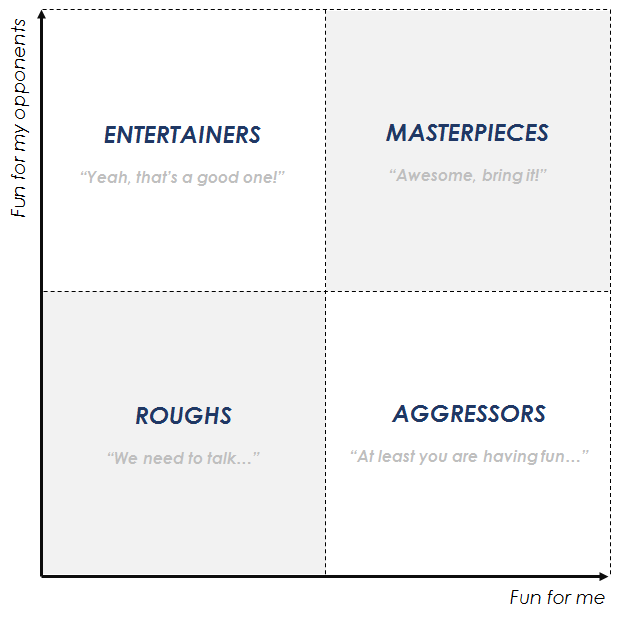
What I ended up with is the following two-by-two matrix.

The Commander Magic Quadrant (CMQ)

Much like Gartner Inc.’s Magic Quadrant, we end up with a two-by-two matrix, aimed at mapping Commander decks within four areas:

  1. Masterpieces are the best of the breed; decks that are both funny for the piloting player and for the rest of the playgroup; they are always a welcome sight at the table and they embody the playgroup’s understanding of what Commander truly is; these can be the culmination of a process in which the whole playgroup learns to understand and respect everyone within it
  2. Aggressors can be the joy of their owner, but a pain for the rest of the tables; decks that are extremely competitive, or include many of the most frowned upon cards in the format can easily end in this category; when these decks show up at the table, they are often met with groans and complains, with their pilot grinning in evil content
  3. Entertainers are loved by the table, but are not equally enjoyed by player piloting them; either these decks are extremely non-competitive, or they are simply closer to the playgroup’s expectations, rather than their deck builder’s; they could have been built this way on purpose, or they can be a meeting point skewed in favour of the playgroup’s preferences
  4. Roughs are the most challenging decks to analyse; they may have been poorly conceived from the start, or maybe they are failed experiments, or they simply lost their charm over time, becoming way more repetitive than expected; another option is simply that, while being still good and playable, they are not as good and beloved as the other decks in the playgroup

Before we move forward, one thing must be mentioned. The Commander Magic Quadrant (CMQ) is not a Cartesian Coordinate System. Its axes do not necessarily go from zero to a maximum possible number, nor usually include negative values. Practically, this means that the centre of the CMQ is not some kind of perfect balance, nor the bottom left corner represents the absolute zero.

The best way to approach the CMQ is to view each item mapped in its areas based on the relative positions between one another. The positioning of each item is therefore not absolute, but can help understanding, within one or more player’s deck roster, how each fare against the others.

Let’s get in the details of this CMQ and understand how to approach it and what its main takeaways can be.

How can one measure fun?

Long story short: fun is unmeasurable. You could try and quantify the amount of endorphin and other substances released by your body when you have fun, but I’m not a doctor and, really, this is way out of my league. What you can do, is separately tackle each of the perspectives we discussed, not trying to measure them, but simply ranking the decks you are trying to map. In other words:

  1. Fun for me: try and rank your decks based purely on your personal enjoyment when you play them; forget your opponents, your win rate, the amount of money spent building it, the type of decks; write them down and, based purely on the amount of fun you usually have playing them, try and list them for the funniest to the least entertaining for you to play
  2. Fur for my opponents: what is your playgroup’s reaction when you bring a certain deck to the table? Do they groan or cheer? Do they smile or complain? Talk to your playgroup and ask them to rank your decks based on how much they enjoy playing against them

Once you have ranked all your decks based on your and your friends’ enjoyment, try and place them in the graph. Funniest for you go to the right, funniest for your playgroup on the top. Again, do not think absolutes, here, but try and distribute all your decks evenly along the two axes. Personally, this is what I ended up with, when I tried distributing my decks.

The Commander Magic Quadrant (compiled)

What really drew my attention, here, is the outliers that place themselves far from the centre of the CMQ. While some of these decks are relatively easy to understand, some may require a bit more context:

  1. My Diaochan, Artful Beauty deck is a pretty straightforward Wacky Chaos Commander deck, with a dense Red Planeswalker subtheme; it is one of the most welcome decks in my playgroup, as it is almost incapable of winning and it always provide some nice twist to traditional games; it fares very low in my personal enjoyment scale as many of its games are just auto-piloted by a number of random effects and the end result is kind of lacklustre
  2. My Kozilek, Butcher of Truth deck is almost the polar opposite: it’s a powerful one trick pony that plays amazingly, but it can be extremely oppressive to play against; meeting a hasty Eldrazi Titan on turn 3 is everything but a funny experience for my opponents and the sheer density of Mana Rocks usually means the deck’s plan feels very consistent and reliable – which is good for me, but not great for the players on the receiving end of an Annihilation 4 trigger
  3. The top positions are split between my Grimgrin, Corpse-Born and my Borborygmos Enraged decks; the two decks have been tuned after years of games and their playstyle is usually perceived as very non-oppressive, relying on anything but game breaking locks and hardly interactive combo
  4. The worst offenders are probably Saskia, the Unyielding and The Locust God; they are both extremely linear in their strategies, but turn out to be less consistent than Kozilek, while still being perceived as pretty non-interactive; the former can potentially take out a player within the first turns of the game, while the latter wins more via a single explosive turn, rather than after a long and well-fought battle

The easier takeaway from this exercise is that I can easily cherry pick what to bring at my local game store, balancing good and interactive games with the occasional nonsense we all need sometimes. This is a great starting point, but we’re barely scratching the surface.

So what is fun?

One thing that immediately comes to mind looking at this matrix is how much one person’s fun can relate to everyone else’s at the table. While the amount of available data is not sufficient to really plot a quantitative correlation, it is indeed possible to theorize some patterns based on one person’s character. In a way, we could easily diagram two perfect extremes in a Commander player’s personality.

To some players, fun is a zero-sum game. The amount of fun they are having is inversely proportional to the amount of fun everyone else is having. If they win, they usually do so by performing something extremely unfair within the game. Joy, to them, is an exclusively individual perspective and the fact that the opponents are having fun can actually be a detriment to their own enjoyment. To some extent, this is an extreme version of Spike from Magic’s personality traits. If they win and everyone else loses, they are happy. Any other scenario results in their discontent. Push it even further and they look like psychopaths who thrive in everyone else’s unease.

On the complete opposite of the spectrum, you have the perfect tablemate. This player’s fun is directly proportional to the amount of fun the whole table is having. Victory is irrelevant, with their only goal being the maximization of the enjoyment within the entire table. Think of these players as Group Hug players pushed to the extreme, to a point where everything they do is make sure everyone else is having fun. Winning a game is so low of a priority to them, that they genuinely never care about the outcome of a game. Again, the extremization of this profile is some kind of selflessness-devoted zealot who only aims at entertaining everyone.

Main character curves on the CMQ

Based on the way one may have plotted their own Commander decks on the CMQ, it is possible to theorize the personality of a player and their approach to the game. The more they approach the Spike curve, the more likely they are to adhere to the idea of a “pure” Spike player, hellbent on winning the game with complete disregard for the opponents’ entertainment. On the other side, the more players approach the Tablemate curve, the more likely they are to move towards a goal of maximized fun for the whole table, disregarding victory as a crucial factor in their own appreciation for the game.

Of course, every player is their own person and it is very likely that perfect adherence to a specific curve is never really achieved, unless the data available is extremely limited, skewing the plotting as a result.

What else there is?

Bridging outside of a single person’s Commander deck roster, two perspectives can be further analysed. First and foremost, comparing individual player’s CMQ can generate interesting comparison between members of a single playgroup, with some being more inclined to individual fun and others more prone to shared entertainment.

With some patience and a lot of effort by everyone involved, another perspective that can be approached is a collective effort within the whole playgroup to rank the entire roster of available Commander decks each player can bring to the table. Based on the size of your playgroup, this can really be a true feat of organizational skills and debate moderation, with the end result being a single shared vertical axis for the entire playgroup. As a result, instead of looking at individual placements of each deck, one could trace the average location of each player roster on the shared CMQ, tracing relative players’ profile and mindsets towards the format and the rest of their teammates.

I may be trying this out for a future update on the subject, so stay tuned if you’re interested.

Glimpse the Future (M14)
Glimpse the Future, art by Andrew Robinson

One additional perspective that can be tackled, going back to an individual’s point of view and driving inspiration from Gartner Inc.’s Magic Quadrant, is a periodical re-assessment of a person’s CMQ. Our personal appreciation of our own Commander decks can really change over time, with new cards being released, new deckbuilding choices to explore and sometimes complete overhauls of existing strategies. While other constructed formats tend to focus on just fine tuning existing strategies, Commander has a way broader mindset and can really lead players to massive reinventions of existing decks or fanatic pursues of new approaches to revamp consolidated decks. I would personally like to revisit my own CMQ over time, especially to see If I managed to improve on the decks I have the least fine playing with and, on the other hand, If I can turn my more oppressive decks into better experiences for my playgroup. Should these be the only results, I’d say we’d already be on a great path of self-improvement.